When UC Riverside Distinguished Professor of Geology Mary Droser began conducting research in South Australia's Flinders Ranges 25 years ago, the remote fossil site where she worked was part of a cattle station.
Today, it is part of Nilpena Ediacara National Park, an internationally significant research site containing some of the world's best fossil evidence of the earliest animal life on Earth. It is also at the center of Australia's nomination of the Flinders Ranges for UNESCO World Heritage status.
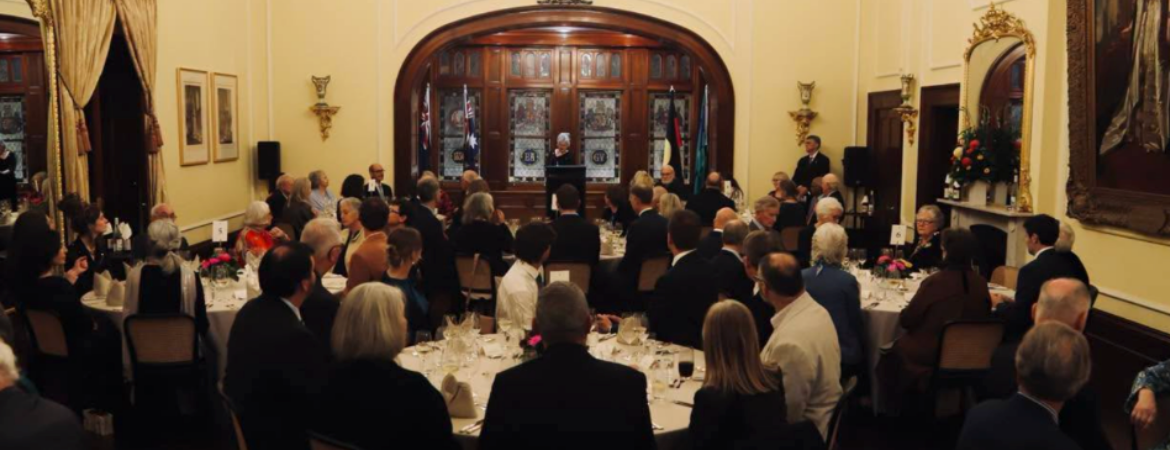
This summer, that decades-long journey brought Droser somewhere very different from the fossil beds of the Australian Outback: Government House in Adelaide, the official residence of the Governor of South Australia.
Droser was joined by UC Riverside College of Natural & Agricultural Sciences Dean Peter Atkinson and graduate students Heather McCandless and Christopher Jones at a dinner hosted by Her Excellency the Honourable Frances Adamson AC, Governor of South Australia, and Mr. Rod Bunten.
The June 24 dinner marked two milestones: Australia's nomination of the Flinders Ranges for UNESCO World Heritage status and the 80th anniversary of Australian geologist Reg Sprigg's discovery of Spriggina, one of the fossils that helped reshape scientific understanding of early complex life.
The evening brought together leaders of the Adnyamathanha people, whose traditional lands include the Flinders Ranges; community representatives; members of Sprigg's family; and leaders in science, culture and conservation — including a UCR research team that has spent decades helping reveal the scientific significance of the landscape.
In her remarks, the Governor repeatedly recognized Droser and her colleagues for their contributions to understanding and preserving Nilpena.
“So much of this has been carried out, or led, by Mary Droser,” the Governor said, describing decades of scientific work that helped establish the global significance of the site.
For Droser, who was elected to the National Academy of Sciences in 2025, the recognition reflected something much larger than the work of any individual researcher.
“It was wonderful to have her acknowledge the contributions of UCR, including the many students involved,” Droser said. “It takes a village to do any of these things.”
Uncovering the Dawn of Animal Life
Droser and generations of UCR graduate students have spent more than two decades studying fossil evidence of some of the oldest animals on the planet.
The fossils are from the Ediacaran Period, roughly 635 million to 539 million years ago, an interval when early complex organisms emerged before the proliferation of animal life during the Cambrian Period.
At Nilpena, Droser's team has excavated fossil beds that preserve ancient seafloor communities, allowing scientists to examine not simply individual fossils but how some of Earth's earliest animals lived, moved, reproduced and interacted with their environments.
Over the years, that research has contributed to something larger.
What was once privately owned pastoral land became Nilpena Ediacara National Park through partnerships involving researchers, landowners, government, conservation organizations and the Adnyamathanha people, whose cultural knowledge and stewardship are integral to the World Heritage nomination.
Now, Nilpena is one of several sites included in Australia's World Heritage nomination for the Flinders Ranges, a 58,000-hectare landscape documenting what the nomination describes as the dawn of animal life.
“The Nilpena nomination is largely based on our research,” Droser said. “The results of our research, the discovery of new taxa, the excavation of fossiliferous beds, form the basis for the World Heritage bid.”
Droser is one of three principal science authors of the nomination. UCR graduate students also played a significant role, with six students contributing to a major scientific comparison of the Flinders Ranges with other fossil sites around the world.
The nomination has cleared an initial completeness review and entered an extensive international evaluation process. UNESCO representatives will visit the sites as part of that review, with a final decision expected later in the process.
If approved, the Flinders Ranges would become the first World Heritage property located entirely within South Australia.
For Droser, however, protecting the landscape is inseparable from understanding it.
“The past informs the future,” she said. “It's important to understand the history of life on planet Earth.”
The fossil record captures not only the emergence and evolution of life, she said, but profound environmental changes, climate shifts and mass extinctions. Understanding that history helps scientists better understand the planet today — and what may come next.
A Ph.D. Experience Beyond the Laboratory
For McCandless, a doctoral student in UCR's Department of Earth and Planetary Sciences, walking through the gates of Government House was a moment she never expected when she began graduate school.
“It is not an experience that I thought I would have as part of my Ph.D.,” McCandless said. “I was just very grateful to have gone, and it was wonderful to see UCR and Mary so prominently acknowledged.”
McCandless began at UCR as a master's student in 2020 before entering the doctoral program in 2022. During that time, her graduate education has taken her thousands of miles from Riverside and given her a front-row seat to what can happen when scientific research extends beyond academic journals.
She has watched a research site become a national park. She has contributed to the scientific work behind a World Heritage nomination. She has worked alongside scientists, government officials, landowners and the Adnyamathanha people.
“Just seeing the level that you can take science and research to has been wonderful,” McCandless said.
Those experiences have also shaped how she thinks about being a scientist.
Research at Nilpena is deeply connected to the people and communities surrounding the site. For McCandless, that has demonstrated the importance of conducting science collaboratively and ethically — not simply arriving at a field site, collecting data and leaving.
“We are very integrated into the community,” she said. “Just having that experience of making research a group effort, a community-based effort” has been an important part of her graduate education.
Droser sees that broader experience as an important part of training the next generation of scientists.
Her students learn paleontology in the field, but they also learn how to work with people whose expertise may come from very different places — fellow researchers, government agencies, conservation organizations, pastoralists and local communities.
“My graduate students in particular have a very unusual, nontraditional field experience,” Droser said. “You're getting a skill set that you wouldn't otherwise get.”
Those skills are developed alongside the scientific work that makes such discoveries possible.
From Riverside to the World
For Atkinson, the evening at Government House represented something larger about the reach of research conducted within CNAS.
The college may be based in Riverside, but the work of its faculty and students is not bounded by California — or even the United States.
CNAS researchers conduct fieldwork, build international collaborations and pursue scientific questions around the world. Their graduate students often work alongside them, gaining experiences that become part of their training as scientists.
“UCR has a global impact,” Atkinson said. “We have faculty going overseas all the time.”
Droser's work in South Australia is an extraordinary example of what that can look like.
Her research has contributed to the scientific understanding of the earliest animals on Earth. It has helped establish the significance of a landscape now protected as a national park. It has informed Australia's bid for international recognition of the Flinders Ranges. And it has created opportunities for UCR graduate students to participate directly in work with scientific, cultural and community significance.
At Government House, that impact was visible.
The Governor welcomed the UCR delegation and recognized the university's contributions before an audience of South Australian leaders. For Atkinson, attending as dean was an opportunity to represent CNAS and acknowledge the significance of the partnerships that have made the work possible.
“It was important for us to be there, to recognize the significance of this work and participate as partners,” Atkinson said.
For McCandless, the experience reinforced what she has discovered during six years at UCR.
“There is no better school I could have picked, no better program I could have picked, to do my Ph.D. with,” she said.
Her advice to students considering graduate school is to remain open to where the experience might lead.
McCandless came to Riverside to study paleontology. She leaves with research experience, international fieldwork, community partnerships and an understanding of how science can help shape decisions far beyond a university.
“Being open to the experience of doing a Ph.D. at UCR has given me more career skills, life skills and research skills than I ever would have hoped to get out of a Ph.D.,” she said.
Sometimes, where a UCR education begins and where it can take you are thousands of miles apart.
Let us help you with your search