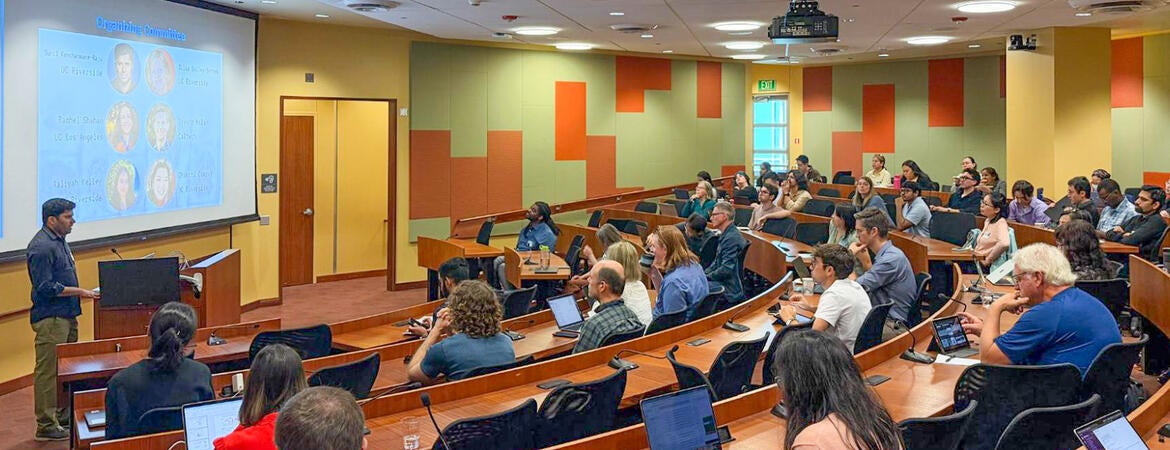
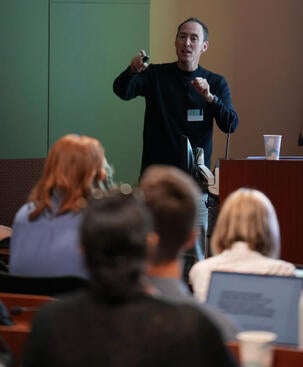
On April 10, 2026, UC Riverside convened researchers from across Southern California and beyond for the inaugural SoCal Single Cell Retreat, a day-long symposium designed to spark collaboration, share emerging discoveries, and position the region at the forefront of single-cell biology.
Hosted on the UCR campus and organized in partnership with UCLA and Caltech, the retreat brought together scientists working across diverse systems, from plant resilience and crop science to human development and disease, united by a common goal of understanding biology at the level of individual cells.
“This is about bringing people together, across institutions, model systems, and technologies,” said Sunil Kenchanmane-Raju, Assistant Professor of Plant Resilience in the Department of Botany and Plant Sciences at UCR and lead organizer of the event. “When we connect those perspectives, we accelerate discovery.”
Positioning UCR at the Center of a Growing Field
Single-cell biology is rapidly transforming how scientists study life, enabling researchers to examine how individual cells behave, interact, and respond to environmental conditions. The field is gaining momentum nationwide,and UCR is positioning itself as a regional leader.
By hosting the inaugural retreat, UCR served as what faculty described as a “nucleator”, a place where ideas, expertise, and partnerships can take shape.
“I think there’s always an opportunity for UCR to bring people together around emerging areas,” said Julia Bailey-Serres, Distinguished Professor with the Department of Botany and Plant Sciences and Director of the Center for Plant Cell Biology. “This is an example of us doing exactly that.”
A Program Designed for Discovery
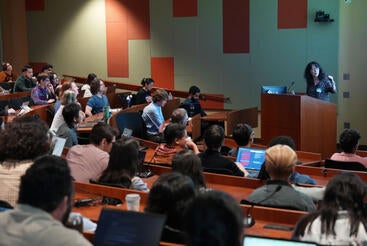
The retreat featured a full day of programming, from morning talks and thematic sessions to poster presentations and an evening reception, structured to encourage both formal knowledge-sharing and informal exchange.
Sessions explored topics such as cellular plasticity and reprogramming in development and disease, cell states across natural and perturbed environments, and emerging technologies pushing the limits of resolution.
Among the day’s featured speakers was D’Juan Farmer, Assistant Professor at UCLA, who opened the retreat with research on how skull bones grow and adapt to support brain development. Using model systems such as zebrafish and mice, Farmer’s work explores how biological structures coordinate growth, insights that have implications for understanding developmental disorders.
“We’re trying to understand how biological systems grow in a coordinated way,” Farmer said. “At the end of the day, this kind of research helps us understand how the body develops, and what happens when things go wrong.”
The program also included presentations from leading researchers across institutions, including Caltech, UC San Diego, UC Irvine, Michigan State University, and Stanford University, reflecting both the depth and breadth of single-cell research today.
Collaboration Across Disciplines and Sectors
A defining feature of the retreat was its interdisciplinary and cross-sector approach. In addition to academic researchers, industry partners sponsored and participated in the event, showcasing technologies and tools that support single-cell analysis.
“The technology itself requires expertise in biology, computation, chemistry, and imaging,” Bailey-Serres said. “Bringing those perspectives together is essential.”
For organizers, this integration of academic and industry voices is key to advancing the field and ensuring that discoveries move from concept to application.
Investing in the Next Generation
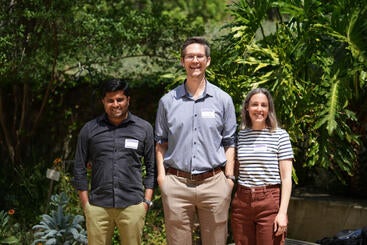
Beyond research collaboration, the retreat also served as a platform for student and postdoctoral development. Graduate students presented their work, engaged with leading scientists, and gained exposure to cutting-edge techniques shaping the future of biology.
“It’s part of their professional growth,” Bailey-Serres said. “These experiences help them think more broadly and connect their work to real-world impact.”
UCR students were prominently featured throughout the program, reflecting the university’s growing investment in training the next generation of scientists in advanced genomic technologies.
For graduate students like Tyler Inskeep, a Ph.D. candidate at UC Riverside, the retreat offered more than exposure, it provided a sense of belonging within a rapidly evolving scientific community.
Inskeep, who presented and won the oral presentation award for his research on how parasitic nematodes reprogram plant root development at the cellular level, said the opportunity to exchange ideas with researchers across institutions helped place his work in a broader context.
“You’re not just working on your own project, you’re part of something bigger,” he said. “Being here and seeing how different approaches connect really changes how you think about your research.”
Looking Ahead
Organizers, including Rachel Shahan (UCLA) and Trevor Nolan (Caltech) emphasized that this year’s retreat marks the beginning of an ongoing regional effort. The event will rotate annually between UC Riverside, UCLA, and Caltech, building a sustained network of collaboration across Southern California.
The retreat also highlighted the broader trajectory of the field. Jonathan Pritchard, Professor of Population Studies, in the departments of Genetics and Biology at Stanford University, whose work focuses on linking genes to complex human traits, emphasized the importance of cross-institutional collaboration in advancing scientific understanding.
“We’re moving toward a much more integrated understanding of biology,” he said. “That only happens when people bring different expertise together and start asking bigger questions.”
For Kenchanmane-Raju, the long-term vision is clear: create a community where researchers not only share knowledge but actively build on one another’s work.
“In single-cell sequencing, individual cells are never enough, every cell has gaps, an incomplete signal. The resolution comes from clustering. That's exactly what we are doing, with researchers across SoCal."
###
Let us help you with your search