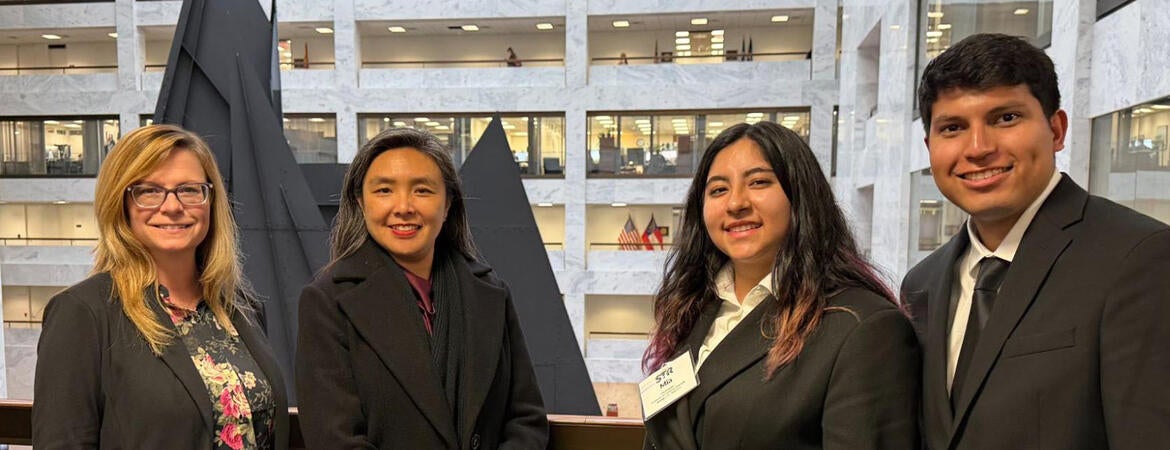
For a group of UC Riverside students, research didn’t just stay in the lab—it took them all the way to Capitol Hill.
From March 1–2, 2026, four Highlanders—Angel Zarobinski, Mia Alvarado, Logan Reynosa, and faculty mentor Dr. Stephanie Dingwall—traveled to Washington, D.C. through the Council on Undergraduate Research (CUR) Scholars Transforming through Research (STR) Program to do something few undergraduates ever experience: advocate directly to federal policymakers for the future of undergraduate research.
Turning Research into a Voice
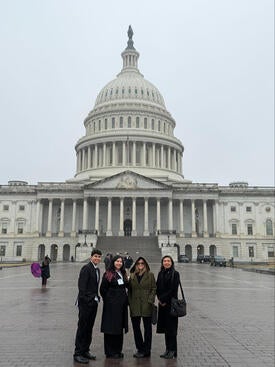
The STR Program is designed to do more than showcase student work—it empowers students to translate their research into real-world impact. On Capitol Hill, that meant meeting with congressional staff and sharing firsthand how research opportunities shape lives, careers, and communities.
“They were nervous at first,” said Dr. Stephanie Dingwall, divisional dean of student academic affairs and associate professor of teaching in biochemistry. “But there was this realization—my work matters, and people in positions of influence want to hear about it. That shift is powerful.”
For many students, it was their first time seeing how science intersects with policy—and how their voices could influence both.
Research That Changes Lives
Each student brought a deeply personal connection to their work.
Angel Zarobinski, a fourth-year plant biology major and transfer student, studies how drought and salinity affect crops like almonds and avocados—research with direct implications for agriculture and food systems. But her journey into science wasn’t linear.
“I might have taken a completely different path,” she said, reflecting on her time before transferring to UCR. “In community college, I was studying nursing and realized it wasn’t for me. Without research, I don’t know if I would have stayed in school. It completely changed the trajectory of my future.”
Now accepted into UCR’s Ph.D. program in plant biology, Zarobinski hopes to become a professor—paying forward the mentorship and opportunity that shaped her path.
Mia Alvarado, a second-year biology major from Riverside, works on cutting-edge research aimed at reducing reliance on fertilizers by engineering nitrogen fixation directly into plants.
But for her, the experience in Washington was about more than science.
“This is another way to create change,” she said. “To show that students—our stories—matter in the decisions being made.”
Logan Reynosa, a second-year molecular biology major, studies retroviruses linked to cancer—work inspired by the loss of his grandfather.
“Research gave me purpose,” he said. “It showed me that what I’m learning can actually make a difference.”
From the Lab to the Legislature
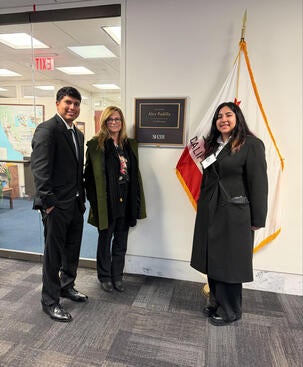
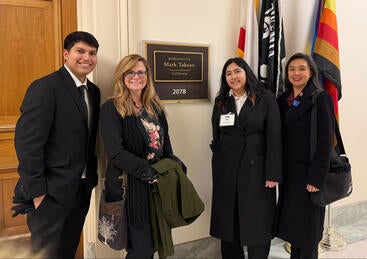
During their time in Washington, the students met with staff from the offices of Senators Alex Padilla and Adam Schiff, as well as Congressman Mark Takano—sharing not just their research, but their stories.
Their message was clear: undergraduate research is not a luxury—it’s foundational.
“Undergraduates are the boots on the ground,” Dingwall said. “They contribute meaningfully to research, yet funding for them is minimal. That’s what we’re advocating to change.”
The students emphasized that early research experiences build critical thinking, spark curiosity, and open doors to careers in science, medicine, and beyond.
And perhaps most importantly—they humanize policy.
“We want them to remember our faces,” Alvarado said. “So when they’re making decisions, they’re thinking about the students those decisions affect.”
Expanding What’s Possible
For all three students, the trip was transformative.
It was Logan’s first time leaving California.
“I realized research isn’t just in the lab,” he said. “It can influence policy, communities—so many different paths I hadn’t even considered.”
For Angel, it reinforced something deeper: that opportunity, once found, can redefine a life.
And for Mia, it connected science with something broader—service, advocacy, and impact.
Why It Matters
At its core, the STR Program reflects a simple but powerful idea: when students engage in research, they don’t just learn—they discover.
They discover new fields. New questions. New futures.
“Research opens windows and doors students didn’t even know existed,” Dingwall said. “It expands not just knowledge, but possibility.”
And now, thanks to their voices on Capitol Hill, these students are helping ensure those doors remain open—for the next generation of Highlanders and beyond.
###
Let us help you with your search