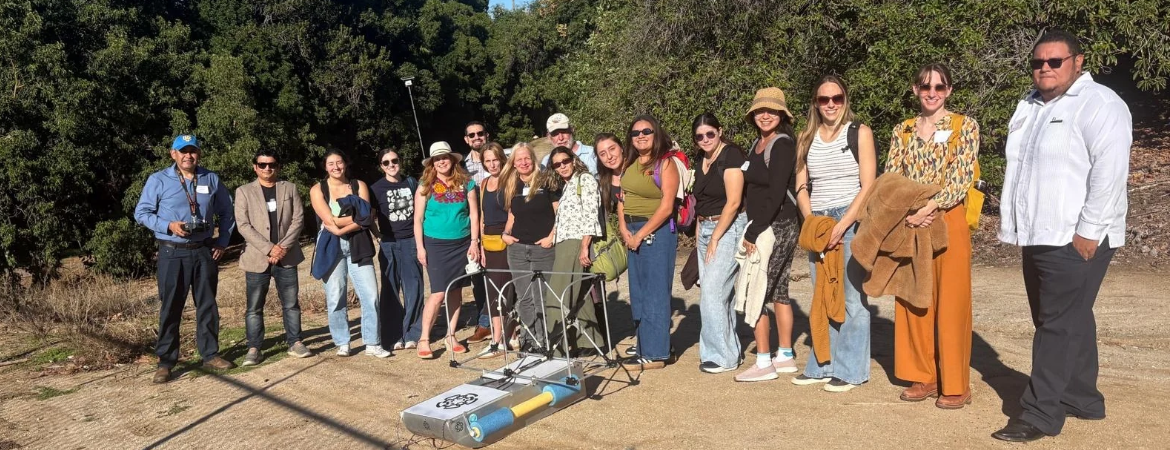
Hosted by UCR's Department of Environmental Sciences, the Alianza UC-MX Aquatic Methane Emissions Workshop brought together researchers studying greenhouse gas emissions across a range of environments, including wetlands, coastal waters, wastewater treatment facilities, and agricultural operations.
The workshop was organized by Francesca Hopkins, Associate Professor of Climate Change and Sustainability in UCR's Department of Environmental Sciences, and postdoctoral scholar Pablo Morales-Rico, with support from UC Alianza MX and campus partners.
For Hopkins, whose research focuses on measuring methane emissions and evaluating California's efforts to reduce them, the workshop provided an opportunity to expand scientific collaborations and explore new measurement techniques.
"I've spent the first 10 years of my career here at UCR really focusing on measurements in California and looking at how California is implementing its methane mitigation policies," Hopkins said. “I'd like to share what we've learned here in California, learn from our colleagues in Mexico, and find new ways to advance our research together.”
Understanding methane's role in climate change
Methane is a powerful greenhouse gas that contributes to global warming. Because it remains in the atmosphere for a shorter period than carbon dioxide, reducing methane emissions can quickly reduce the amount in the atmosphere. It is considered one of the most effective ways to slow warming in the near term.
California has established ambitious methane reduction targets, including a goal of reducing emissions by 40 percent below 2013 levels by 2030.
Understanding where methane originates, how much is released, and how emissions change across different environments is essential to evaluating the effectiveness of these efforts.
Hopkins and her research team have spent years measuring methane emissions using a variety of technologies, including satellite observations, ground-based instruments, and a mobile laboratory that collects atmospheric measurements at dairy farms, landfills, and oil fields.
However, measuring emissions from aquatic environments presents a different set of challenges.
Methane is often produced when organic matter decomposes in environments with little or no oxygen, making wetlands, wastewater systems, and other water-rich environments important areas of study.
"Most of my research has focused on measuring methane emissions in soil and air," Hopkins explained. "Aquatic environments present a different set of challenges, requiring new approaches and techniques to better understand these emissions."
The workshop brought together scientists with expertise in different ecosystems and measurement methods to examine those challenges and identify opportunities to work together.
Sharing expertise across borders
A central focus of the workshop was strengthening research partnerships between the University of California and Mexican institutions.
Among the participants were researchers from Cinvestav in Mexico City, Dr. Eduardo Espinoza Quesada, and Dr. Frederic Thalasso, who brought specialized uncrewed surface vehicles and experience measuring methane emissions in wastewater treatment systems.
The collaboration grew out of Hopkins' work with Morales-Rico, who completed his doctoral studies in Mexico before joining UCR as a postdoctoral scholar.
Their shared interest in methane measurement led to an opportunity to connect researchers with complementary expertise.
Hopkins' team has extensive experience measuring methane in the atmosphere, while their Mexican collaborators have developed techniques for measuring emissions directly from aquatic environments.
"Our Mexican collaborators have this amazing technical knowledge of how to measure some of these systems– that we can learn a lot from one another," Hopkins said.
One highlight of the workshop was a demonstration of an autonomous surface vehicle equipped with technology designed to measure methane emissions from water.
Developed by the visiting researchers, the vehicle was demonstrated at a reservoir on the UCR campus, giving participants an opportunity to see the technology in action and discuss potential research applications.
Hopkins and her team hope to adapt similar technology for use at California dairy farms, where wastewater storage and treatment systems can be significant sources of methane emissions.
The demonstration also laid the groundwork for additional field research with the Mexican collaborators.
Building a broader scientific community
The workshop featured presentations, panel discussions, and opportunities for researchers to exchange ideas about measuring greenhouse gas emissions across different ecosystems.
Participants represented multiple University of California campuses, including UC Irvine, UCLA, and UC Santa Cruz, along with researchers from Mexico.
Adina Paytan, a professor at UC Santa Cruz whose research includes quantifying greenhouse gas emissions from wetlands, said the gathering offered an opportunity to learn from scientists working in different environments.
"Every system is really different in terms of the amount of greenhouse gas emissions, but there are some commonalities that will facilitate learning from each other," Paytan said.
She noted that comparing ecosystems in California and Mexico could help researchers better understand how differences in climate, environmental conditions, and infrastructure influence methane emissions.
The workshop also highlighted the value of combining different scientific approaches.
"No one lab really has the ability to look at all these scales and different processes," Hopkins said. "The best way we can do that is just by working together."
Turning scientific exchange into lasting partnerships
UCR Vice Chancellor for Research and Economic Development, Rodolfo Torres, welcomed participants and emphasized the importance of international research partnerships in addressing shared environmental challenges.
Torres, who also serves in a leadership role with Alianza MX, described the workshop as an example of how collaboration can bring together expertise, resources, and new approaches to complex scientific problems.
"These challenges do not stop at national borders, and neither should our scientific collaboration," Torres said.
Alianza MX supports partnerships between the University of California and institutions in Mexico, helping researchers develop connections that can lead to larger collaborative projects.
For Hopkins, the November 3 gathering represented a starting point rather than a conclusion.
Beyond exchanging research findings and demonstrating new technology, she hopes the relationships established during the workshop will lead to future studies, joint research proposals, and improved methods for understanding methane emissions.
Those advances could ultimately help scientists and policymakers better assess efforts to reduce greenhouse gases and limit the impacts of climate change.
"Building new relationships is an important part of what we're doing here," Hopkins said. "When you bring together researchers with different perspectives and expertise, that's where new and creative ideas emerge."
Let us help you with your search