The College of Natural & Agricultural Sciences (CNAS) at UC Riverside welcomed 13 new faculty members in 2026, bringing expertise across seven academic departments in fields ranging from quantum science and neuroscience to sustainable agriculture, environmental chemistry and ecology.
The new faculty members will advance the college's research, teaching and public service missions, addressing scientific challenges related to human health, environmental sustainability, crop productivity and the fundamental processes that shape the natural world.
Meet the new CNAS faculty
Department of Botany & Plant Sciences
Maria Florencia (Flor) Ercoli, an assistant professor of botany and plant sciences, received her doctorate in Biological Sciences from the Universidad Nacional de Rosario, Argentina. She completed her postdoctoral training at UC Davis as a Pew Latin American Fellow. Her research explores how root development and root-derived chemistry shape soil microbial communities to improve crop productivity, reduce greenhouse gas emissions, and advance sustainable agriculture. She is also an investigator at the Innovative Genomics Institute at UC Berkeley.
Sara Ohadi, an assistant cooperative extension weed management specialist, received her doctorate from the University of Melbourne. She leads UCR’s Integrated Weed Science Lab. Her research and extension program focuses on precision weed management, weed ecology and biology, population genetics, and integrated approaches to managing weeds in California agronomic cropping systems. Before joining UCR, she worked for Bayer CropScience.
Carol Tardivo, an assistant professor of horticulture in the Department of Botany and Plant Sciences, received her doctorate in horticultural sciences from the University of Florida. At UCR, her research will develop strategies to help the California citrus industry and specialty crop systems adapt to biotic and abiotic stresses. Her previous research focused on managing citrus greening (HLB), from protective covers and testing of novel rootstocks to trunk-injected therapies.
Maggie Sogin, an assistant professor of ecological metabolomics, received her doctorate in zoology from the University of Hawaii, Manoa. She trained as a postdoctoral fellow at the Max Planck Institute for Marine Microbiology. Prior to joining UCR, she was an assistant professor at UC Merced. Her research is centered in studying host-microbe interactions in marine plants and animals.
Department of Environmental Sciences
Uriel De Jesus Garza Rubalcava, an assistant professor of environmental chemistry, received his doctorate in chemical engineering from Texas Tech University. His research focuses on the reactive transport of legacy and emerging contaminants in subsurface environments using both experimental and numerical modeling approaches. Before joining UCR, he completed a postdoctoral fellowship and became an assistant professor of research at Brown University.
Department of Evolution, Ecology & Organismal Biology
Piatã Marques, an assistant professor in the Department of Evolution Ecology & Organismal Biology, received his doctorate from the University of Victoria in Canada. His research focuses on understanding the interactions between ecology, evolution and people in urban aquatic ecosystems to advance ecological theory while also generating practical knowledge that empowers communities and informs decision-making. Prior to joining UCR, Marques was a research fellow at the University of Toronto Scarborough and an assistant professor at SUNY Buffalo.
Department of Mathematics
Thomas Bury, an assistant professor of mathematics, received his doctorate in applied mathematics from the University of Waterloo and completed postdoctoral research at McGill University. His research combines mathematical modeling and machine learning to understand and anticipate critical transitions in complex systems. His current work focuses on cardiac arrhythmias, in collaboration with physicians and experimental physiologists.
Department of Microbiology & Plant Pathology
Tibo Duran, an assistant professor of Microbiology and Plant Pathology, earned his doctorate in pharmaceutical sciences from the University of Connecticut. His lab develops AI/ML-driven computational frameworks that integrate data-driven models with physics-based simulations to understand molecular mechanisms, predict crop disease risks, and design innovative solutions for sustainable agriculture and human health. His experience includes academic and industry research, including early drug discovery.
Elizabeth Brauer, an assistant professor in fungal biology, received her doctorate from Cornell University. Her research focuses on plant-microbe interactions and plant innate immunity. She examines the attack strategies of agriculturally relevant pathogens and uncovers the plant defense responses that provide resistance against attack. Her work reveals genetic targets for improving cereal disease resistance and novel approaches for disease control. Prior to joining UCR, she was a research scientist at Agriculture & Agri-Food Canada.
Department of Molecular, Cell & Systems Biology
Yan Hong, an assistant professor in the Department of Molecular, Cell and Systems Biology, earned her doctorate in Neuroscience from Emory University and completed postdoctoral training at the University of Pennsylvania. The Hong Lab studies how disease-associated genetic variants alter neural development and function in neuropsychiatric and neurodevelopmental disorders using human induced pluripotent stem cell (iPSC)-derived 2D neuronal and glial models and 3D brain organoids.
Ting Zhao, an assistant professor of molecular, cell and systems biology, received his doctorate from Emory University where his research focused on the cellular mechanisms underlying Huntington’s disease. He later conducted postdoctoral research at the University of Pennsylvania, studying epigenetic and epitranscriptomic mechanisms in brain development. His research examines how RNA modifications regulate DNA repair in brain cells, with the goal of better understanding the molecular processes that maintain brain health and contribute to neurological disease.
Department of Physics & Astronomy
Anand Bhattacharya, a professor of physics and astronomy, received his doctorate at the University of Minnesota. He spent nearly two decades as a physicist/materials scientist at Argonne National Laboratory. He is interested in novel superconducting, magnetic and topological states that emerge at surfaces and interfaces between different materials. His research group at UCR will synthesize these materials in atomic layer-by-layer manner, explore their properties, develop fundamental insights and possible applications in quantum science and engineering.
Ben Donovan, an assistant professor of physics and astronomy, completed his doctorate in biophysics at The Ohio State University and a postdoctoral fellowship at the National Cancer Institute. His research group probes the temporal regulation of RNA processing using single-molecule approaches.
Supporting faculty success through orientation and collaboration
CNAS hosted its fall New Faculty Orientation on October 14 at the CNAS Dean's Office, introducing incoming faculty to college leadership, academic resources and support services.
Dean Peter Atkinson welcomed participants and emphasized the importance of interdisciplinary collaboration, drawing on his nearly 30 years at UCR and his own experiences working with researchers beyond his home department.
"A big part of my job is to enable the faculty, just like it is enabling the students to meet their career aspirations," Atkinson said.
He encouraged faculty to remain focused on their research, teaching and service while exploring opportunities for collaboration across disciplines.
"You are in the right place, in the right profession, at the right time," he said.
Throughout the afternoon, CNAS divisional deans and representatives from academic and administrative units presented resources supporting student success, faculty advancement, research, development, financial administration, facilities and communications.
The orientation concluded with a campus tour led by CNAS staff and Science Ambassadors, giving participating faculty an opportunity to explore the university and become more familiar with the campus.
Connecting with colleagues at the CNAS New Faculty Reception
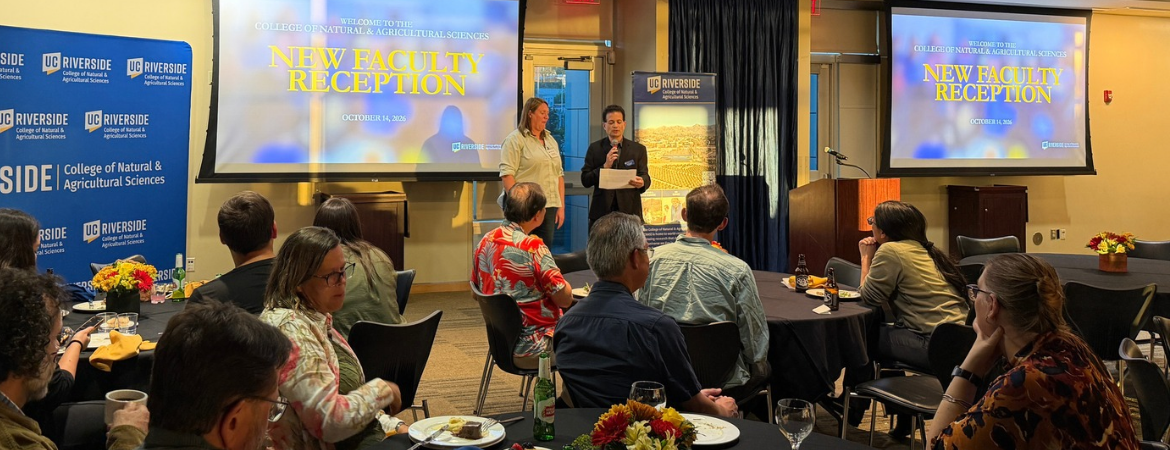
The day's activities continued with the CNAS New Faculty Reception at the UCR Alumni & Visitors Center, bringing together new faculty, college leadership, department chairs and colleagues for dinner and networking.
Following opening remarks from Atkinson, department leaders introduced new faculty from Botany & Plant Sciences; Environmental Sciences; Evolution, Ecology & Organismal Biology; Microbiology & Plant Pathology; and Physics & Astronomy.
The reception offered an opportunity to build relationships across departments and strengthen connections within the CNAS community.
Let us help you with your search