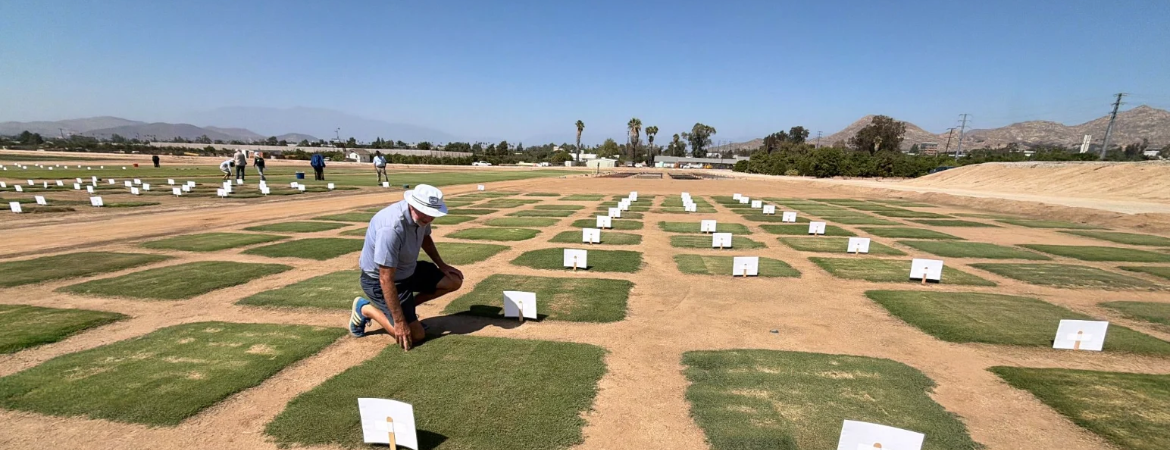
Across a patchwork of green research plots at UC Riverside, thousands of experimental grasses are being put to the test.
Some are subjected to weeks without irrigation. Others are evaluated for disease resistance, winter color, heat tolerance or their ability to stay healthy with less water. Most will never leave the research field. A select few will advance through years of testing.
And every once in a while, one makes it all the way from a small UCR research plot to landscapes across the West.
That is what happened with Coachella Bermuda™, a hybrid bermudagrass developed at UCR that combines improved drought resistance with a shorter winter dormancy period. Licensed to West Coast Turf in 2025, Coachella Bermuda is now growing on golf courses in Southern California, with additional projects on the horizon.
On Thursday, Sept. 17, turfgrass professionals, industry partners and other visitors came to UCR's Agricultural Operations for the 2026 Turfgrass and Landscape Research Field Day to see both the research already making an impact and what might come next.
The annual event brought visitors directly into UCR's research fields for a series of stops examining turfgrass breeding, drought and water conservation, disease management, irrigation requirements and other challenges facing landscapes in California and the Southwest.
For Professor and Cooperative Extension Turfgrass Specialist Jim Baird, the Field Day provides an opportunity to demonstrate the breadth of a research program increasingly centered on a fundamental challenge: maintaining healthy, functional landscapes while using less water.
“We're trying to develop grasses that use less water,” Baird said. But breeding is only part of the solution. Researchers are also evaluating products, irrigation strategies and management practices that can reduce water use in existing landscapes.
“We're the leaders in that area of trying to identify just kind of a total programmatic approach to saving water,” he said.
From a research plot to the golf course
Coachella Bermuda offers a glimpse of what can happen when that research moves beyond UCR.
The hybrid bermudagrass emerged from a breeding program reestablished at UCR in 2012. Nearly 5,000 hybrids have been generated since the program began, with researchers selecting and testing grasses for characteristics including drought resistance, winter color retention and performance under different growing conditions.
Coachella Bermuda ultimately distinguished itself with its dark blue-green color, improved drought resistance and shorter winter dormancy period. UCR released and licensed the cultivar to West Coast Turf in 2025.
It has since made the leap from experimental plots to commercial production.
The Farms Golf Club in Rancho Santa Fe became the first golf course to establish Coachella Bermuda, reopening following a renovation in October 2025. Big Canyon Country Club in Newport Beach followed, establishing Coachella Bermuda across tees, fairways and rough as part of its renovation.
Baird said seeing a grass developed at UCR performing in real-world conditions has generated new momentum for the breeding program.
“We're excited,” Baird said. “It's gaining a lot of momentum.”
For West Coast Turf, which has partnered with UCR's turfgrass program for years, the process illustrates the role industry can play in moving university research into the marketplace.
John Foster, President of West Coast Turf, said the company worked with UCR to evaluate the new grass, license it and begin commercial production. As inventory increases, the company expects to expand Coachella Bermuda beyond golf courses and explore applications in residential and other landscapes.
The partnership also creates a return to the university through royalties on sales of the cultivar, supporting the cycle of research that can lead to future varieties.
Searching for the next Coachella Bermuda
Back at UCR, that search is already well underway.
Among rows of small experimental plots, UCR researchers are currently evaluating approximately 2,000 unique bermudagrass genotypes, according to Christian Bowman, a UCR postdoctoral researcher who serves as the program's warm-season turfgrass breeder.
Bowman earned his Ph.D. in Plant Biology at UCR in 2024 and now manages breeding objectives and research for the program's bermudagrass and kikuyugrass collections.
The numbers shrink dramatically as plants move through the breeding process. Only about six to 10 promising experimental lines may advance into trials where they are compared directly against established commercial cultivars.
“If we have grasses that aren't as good as or better than what's already available, there's no point in releasing them,” Bowman said.
Several experimental lines currently undergoing drought trials in Riverside are attracting significant attention. Researchers noted that the candidate grasses demonstrated remarkable resilience, remaining green nearly 53 days without irrigation while surrounding grasses showed considerably greater drought stress.
But exceptional drought tolerance alone does not make a new cultivar. Researchers must continue evaluating the grass for other characteristics and performance across different environments before determining whether it should advance.
“The goal of the breeding program is to combine as many positive traits as we can into one grass,” Bowman said.
That long process of generating genetic variation, identifying promising plants and testing them repeatedly against the best grasses already available is how a small experimental plot can eventually become a cultivar like Coachella Bermuda.
Research designed to be used
Breeding was only one part of what visitors saw during Field Day.
Six research stops highlighted studies ranging from fungicides for anthracnose and summer patch diseases to bermudagrass drought recovery, products for reducing water use, improved kikuyugrass, and research updating irrigation requirements for warm-season turfgrasses.
Some of that work has implications beyond identifying which products perform best.
Baird noted that pesticide products seeking registration in California require California data, making UCR's field research valuable to both regulators and companies developing products for use in the state.
Industry partners also help support research and provide products for experimental testing, allowing UCR researchers to evaluate them independently under Southern California conditions.
Field Day creates a place for those researchers, companies and the people who ultimately manage landscapes to interact directly.
For Peggy Mauk, Director of Agricultural Operations at UCR, that exchange is an important part of the mission of the research station.
UCR's Agricultural Operations encompasses approximately 420 acres, but much of it remains largely unseen by people who pass the university along Martin Luther King Boulevard and Canyon Crest Drive. Mauk estimates that the turfgrass program itself has grown from approximately six acres when she became director in 2011 to roughly 10 acres today.
Events like Field Day bring people through the gates.
“A lot of the city doesn't even know we exist,” Mauk said. “They just know there's a campus there. They don't realize the breadth of the research station.”
Over the years, Field Day has drawn not only turfgrass professionals but representatives from cities, school districts and other organizations responsible for managing large landscapes. That creates opportunities for UCR research on irrigation, turf varieties and landscape management to reach the people who can put it to use.
That connection between research and application is central to Cooperative Extension, said Peter Kelly, an event specialist with UC Agriculture and Natural Resources.
“The work that goes into these research projects is meant to reach the public,” Kelly said. “We want to make sure people facing these challenges have access to solutions they can use.”
Science for a drier future
For CNAS Dean Peter Atkinson, the work taking place in UCR's turfgrass plots represents something larger.
Southern California provides a natural laboratory for understanding how plants can remain productive under heat, drought and increasingly limited water resources. Those questions apply not only to turfgrass but to agriculture and managed landscapes throughout arid and semi-arid regions.
Atkinson described Baird's program as an example of the value of Cooperative Extension and of researchers working directly with industry to produce outcomes that can be put into practice.
“A lot of what we do must have applied outcomes,” Atkinson said. “It's about delivering a return on the investment made by the public and taxpayers. That's what University of California science is all about.”
The challenge is unlikely to become less important.
Water efficiency, Atkinson said, will increasingly shape how agriculture and landscapes are managed in California and other dry regions of the world, putting UCR in a distinctive position to develop and test solutions.
For now, some of those possibilities are growing quietly in small plots at the edge of campus.
Most will remain experimental grasses identified only by numbers. Some will advance to another round of testing.
And somewhere among them may be the next Coachella Bermuda.
Let us help you with your search