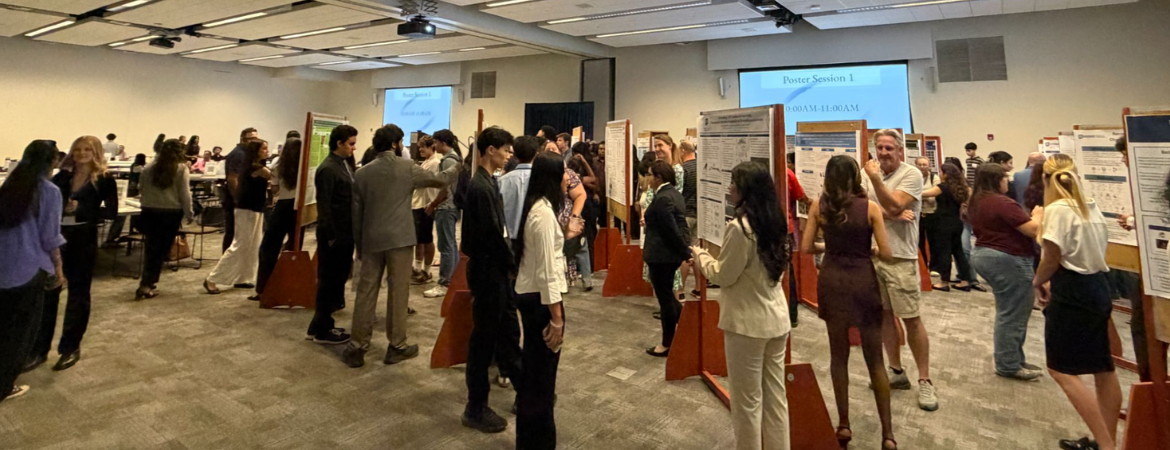
After 10 weeks studying everything from sustainable housing and climate change to genetics and antimicrobial resistance, nearly 100 undergraduate researchers gathered at UC Riverside on Aug. 26 to share what they had discovered.
For many, the RISE & MARC Summer Research Symposium marked their first opportunity to present scientific research before faculty members, graduate students, fellow researchers and family members. But the presentations represented only one part of a summer designed to introduce students not only to research, but to the community that surrounds it.
Now in its 16th year, Research in Science and Engineering, or RISE, brings undergraduate researchers from across UCR and several research programs into a shared summer experience built around faculty mentorship, professional development and scientific communication.
“RISE is a catalyst for students to experience undergraduate research with our CNAS faculty,” said Noel Salunga, assistant director of student success programs in UCR’s College of Natural and Agricultural Sciences and RISE program manager. “Students are transforming from consumers of knowledge to producers of knowledge.”
Building a research community
RISE is unusual because its students do not necessarily arrive through a single program or source of funding.
This summer's participants included students supported through the California Alliance for Maximizing Potential, or CAMP; Dynamic Genome Summer Scholars; CNAS Learning Community Scholars; CNAS Summer Bridge to Research; a USDA-NIFA research program; faculty research grants; and other sources.
What RISE provides is the infrastructure that brings those students together.
Students spend the summer conducting research alongside faculty members, graduate students, postdoctoral researchers, lab managers and peer mentors. They also participate in professional development and networking opportunities and prepare to communicate their work through oral and poster presentations.
Faculty members with their own undergraduate researchers can also connect their students with RISE, giving students access to a broader community beyond their individual laboratories.
“Faculty want their students in their lab to be connected with the broader RISE community,” Salunga said. “They want them to have opportunities to learn from and engage with other undergraduate researchers over the summer.”
That community is an important part of the experience, said Amanda Arrieta, RISE assistant coordinator.
“RISE is so much more than the research that you do,” Arrieta said. “There are so many opportunities.”
Arrieta knows that experience from several perspectives.
She first participated in RISE before transferring to UCR from Riverside City College through its Bridges to Baccalaureate program. After transferring, she remained involved with RISE and served as a peer mentor for two summers. Following her graduation from UCR, she returned this summer as the program's assistant coordinator.
For students entering research for the first time, she said, RISE can provide an entry point into an environment that might otherwise be difficult to navigate.
“RISE is designed for undergraduate students who may not yet have research experience,” Arrieta said. “It provides an opportunity to begin developing those skills.”
Discovering what research can offer
Jianna Parada entered the summer with no previous research experience.
An incoming third-year environmental engineering student in UCR's Marlan and Rosemary Bourns College of Engineering, Parada participated through CAMP and worked on a sustainable housing project examining how the geometry and design of modular housing could reduce construction costs, energy consumption and carbon emissions.
At the symposium, she presented her research during one of the day's oral presentation sessions.
“I would highly recommend it, especially if you are starting off with absolutely no research experience,” Parada said. “I had none before this.”
Beyond learning how to conduct research, Parada said the experience changed how she viewed her own abilities.
“It changed how I saw myself, helping me develop greater confidence in what I can accomplish,” she said.
For Anoushka Bellum, a neuroscience major entering her second year at UCR, the summer offered an early opportunity to experience the realities of research.
Working in Assistant Professor Kieran Samuk's lab, Bellum studied chromosomal inversions in flies and how their frequency may be changing in response to climate change. She presented her work in a poster session at the symposium — her first time presenting scientific research.
Bellum said spending an entire summer in the lab also taught her something that extends beyond the science.
“Research is a process of learning and discovery, so I had to stay patient and keep going,” she said. “The experience made me more patient.”
She plans to continue working in the lab during the academic year.
From conducting research to communicating it
The Aug. 26 symposium brought together 94 students for three oral presentation sessions and two poster sessions.
The event was co-hosted for the third year by RISE and UCR's Maximizing Access to Research Careers, or MARC, program, a separate year-round research training program focused on preparing undergraduate students for biomedical research graduate programs.
For RISE students, the symposium provided an opportunity to practice another essential part of being a researcher: explaining their work to others.
“The ability to share and communicate their scientific findings, their methods, what their experience was like and their discoveries — that's important,” Salunga said.
CNAS Dean Peter Atkinson told students during the symposium that the breadth of research represented in the room reflected both the range of science at UCR and the opportunities ahead of them.
“Science matters, and engineering matters,” Atkinson said. “There are so many questions. There are so many opportunities that are out there.”
For Salunga, those opportunities are ultimately what RISE is designed to help students discover.
Some students will continue in their laboratories and pursue master's or doctoral degrees. Others may take the research, communication and professional skills they developed into industry, education or other careers.
What matters, he said, is giving students an immersive experience that allows them to begin seeing themselves not simply as students learning science, but as people capable of contributing to it.
Support from donors, faculty research grants and institutional funding helps make RISE experiences possible, including student stipends, research supplies and professional development opportunities. A $6,500 gift can support an undergraduate researcher through the 10-week summer program.
To learn more about RISE or support undergraduate research, visit the RISE website.
Let us help you with your search