For Sarah Fan, figuring out that she wanted a future in research also meant figuring out what kind of research she wanted to pursue.
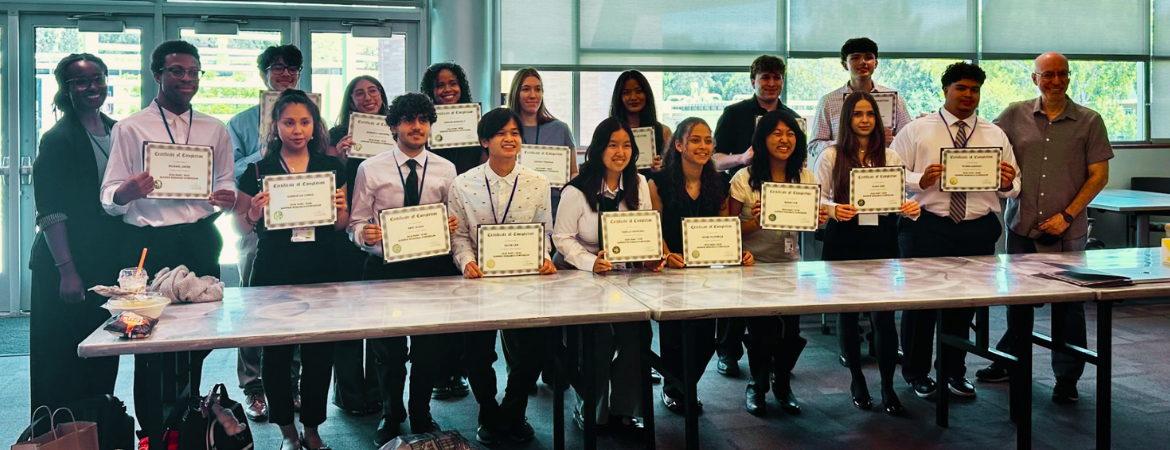
The UC Riverside student had already experienced undergraduate research through the RISE program, where she worked in ecology. As a scholar in UCR's Maximizing Access to Research Careers, or MARC, program, she had the opportunity this summer to take another step — conducting research at UC San Diego School of Medicine.
There, Fan worked in the laboratory of Victor Nizet, Distinguished Professor of Pediatrics and Pharmacy, studying proteins associated with Klebsiella pneumoniae, a bacterium that can cause serious hospital-acquired infections. Her research could ultimately contribute to the development of new drugs or vaccines.
The experience helped Fan narrow her interests toward translational research and reinforced her decision to pursue graduate education.
“I think the MARC program has given me the opportunity and the exposure to know what I like and what I want to pursue in research,” Fan said.
She is now preparing to apply to master's and Ph.D. programs.
That progression — from gaining research experience to developing the skills and preparation needed for graduate-level research — is at the heart of MARC.
Preparing students for graduate research
Funded by the National Institutes of Health, MARC is a year-round undergraduate research training program designed to prepare students to pursue research-focused graduate degrees in the biomedical sciences.
Unlike a summer research experience, MARC requires an extended commitment to research and professional development. The program currently supports a cohort of 14 students who conduct research throughout the academic year and work full time in research during the summer.
“The goal is really to prepare them to be pre-graduate students or graduate students when they exit the program, so that they can apply to Ph.D. programs and be very competitive,” said Ernest Martinez, Professor of Biochemistry and MARC program director.
Research is only one component.
MARC scholars also complete specialized courses designed to strengthen skills including scientific communication, critical analysis and navigating research environments. They attend and present at scientific conferences and receive guidance on graduate school and research careers.
“We want our students to be curious thinkers, innovative and to take charge of their careers,” said Rebecca Brown, MARC program manager.
The program also encourages students to broaden their research experience beyond UCR. MARC scholars are expected to spend at least one summer conducting research at another institution.
For Fan, that meant spending the summer at UC San Diego.
MARC provided $3,500 toward travel, housing and other expenses, allowing her to concentrate on the research experience.
“I think they really prepare you for a future in research,” Fan said.
Learning to think and communicate as scientists
MARC scholars joined other undergraduate researchers Aug. 26 for the RISE & MARC Summer Research Symposium at UCR.
Now in its third year as a jointly hosted event, the symposium gave students opportunities to communicate their summer research through oral and poster presentations.
Fan delivered an oral presentation on her UC San Diego research.
“It's definitely really intimidating,” Fan said of public speaking. “But I think it also shows why there should be opportunities like this, so you can have the experience to go out of your comfort zone.”
Martinez said learning to explain research — and respond to questions about it — is an important part of becoming a scientist.
“The first thing is confidence,” Martinez said. “Every time you stand up in front of an audience and you need to talk about your research, you might get intimidated. They realize that they can do it, and they will be able to do it again and again.”
The preparation behind those presentations is equally important, he said. Students must determine how to explain complicated research to a broader audience, decide which findings are most important and learn to respond to questions they may not have anticipated.
Those skills are developed over the course of the MARC experience.
Finding a direction through research
For Sari Sleem, a cell, molecular and developmental biology major entering his second year at UCR, MARC provided an early opportunity to explore his interest in stem cell and regenerative medicine.
Working in Assistant Professor Iman Noshadi's bioengineering laboratory, Sleem helped develop a soft, bioadaptable scaffold that could eventually be used to grow human cells outside the body.
Potential applications include testing medications on human tissue or developing new approaches to tissue engineering.
“I hope to get a Ph.D. in stem cell and regenerative medicine,” Sleem said. “I'm really interested in stem cell research in general.”
MARC has given him an opportunity to begin exploring that field while also providing future opportunities to attend conferences and participate in research experiences at other institutions.
For Martinez, that sustained exposure is what allows students to enter graduate programs already understanding the expectations of research.
MARC alumni have gone on to graduate and postbaccalaureate programs at institutions including Harvard University, Stanford University, Johns Hopkins University, the University of Michigan, UC San Diego and UCR.
The program also brings alumni back to speak with current scholars about their experiences.
Students hear from researchers who once faced many of the same questions about graduate school, laboratories and scientific careers that they are now navigating themselves.
“They serve as role models,” Martinez said. “They demystify certain things. Students can say, ‘If they can do it, I can do it too.’”
For Fan, the progression from RISE to MARC and then to an external research experience helped answer one of the most important questions an undergraduate researcher can ask: What kind of scientist do I want to become?
“Knowing what you don’t like is just as important as figuring out where your passions lie,” Fan said.
For her, that process has led toward translational research — science that can ultimately move beyond the laboratory and improve human health.
“I want to be able to translate it to humans and for someone to use,” Fan said.
Let us help you with your search