How does research happening at UC Riverside make its way into a middle or high school classroom?
By connecting the researchers with the people teaching the next generation of scientists.
Local science teachers returned to the classroom Aug. 4-5 — this time at UC Riverside — for the second annual CNAS Summer Science Symposium, a two-day program designed to connect middle and high school educators with UCR researchers and give them new ideas, experiences and scientific knowledge to take back to their students.
Launched last year as a partnership between the College of Natural & Agricultural Sciences and Riverside Unified School District, the symposium expanded this year to include teachers from Riverside Unified, Moreno Valley Unified and Corona-Norco Unified school districts.
For Julie Smith, Instructional Services Specialist for TK-12 Science at Riverside Unified, bringing educators together across district lines adds another dimension to the partnership.
“It's important to think beyond our own district — it's the whole region that we want to grow and prosper,” Smith said. “Every district does things differently; creating opportunities for teachers to share best practices means we can get really good ideas from each other.”
The science expanded, too.
After focusing on Earth and Space Sciences during the inaugural symposium, this year's program introduced teachers to research spanning physics, biology and ecology, entomology, chemistry, environmental science, microbiology and biochemistry.
“The more connections we can build, the more we can all grow together,” said Stephanie Dingwall, CNAS Divisional Dean of Student Academic Affairs and Professor of Teaching in Biochemistry. “UCR is not just siloed. We're out there with the community, interacting with the community, communicating with the community, bringing the science passion out there, hearing what they need and hearing what they want.”
From quantum materials to Riverside wildlife
The first day brought teachers to the Glasgow Dining Room Conference Room, where UCR faculty introduced them to research happening across CNAS. The program also included a CNAS student panel and concluded with a tour of a microbiology laboratory in Pierce Hall led by Jason Rothman, Assistant Professor in the Department of Microbiology & Plant Pathology.
The research ranged from the microscopic to issues unfolding in the teachers' own communities.
Assistant Professor of Physics and Astronomy Andrew Joe introduced teachers to two-dimensional materials and emerging quantum technologies in “Building Quantum Materials One Atomic Layer at a Time.” Joe said connecting university researchers with local educators can help students understand where the science they are learning today can eventually take them.
“Teachers are the first point of contact for our future scientists,” Joe said. “By working together, we can bridge the gap between foundational classroom science and cutting-edge university research, ensuring students see a clear, exciting pathway to STEM careers right here in their local community.”
Associate Professor of Biology Marko Spasojevic brought the science even closer to home. His presentation, “What's Wild in Riverside,” highlighted research using camera traps and environmental DNA, or eDNA, to understand wildlife diversity throughout Riverside County and how human activity affects where animals live and when they are active.
Associate Professor of Entomology Amy Murillo explored California blow flies and the threat of the invasive New World Screwworm. Murillo's research examines Southern California blow fly populations and how climate and urbanization affect them, while also helping prepare California for the potential arrival of the invasive screwworm, an agricultural pest that feeds on the living tissue of warm-blooded animals.
Assistant Professor of Chemistry Kevin Kou introduced teachers to “Organic Chemistry at UCR and What We Do,” connecting organic chemistry to everyday life and highlighting research conducted by students in his lab. His presentation focused in part on natural products — molecules produced by nature — and how scientists synthesize them and investigate their biomedical and ecological potential.
Professor of Groundwater Hydrology Hoori Ajami connected her research to another issue with particular relevance to inland Southern California: water and agricultural sustainability. Ajami said partnerships with local teachers provide an opportunity to translate university research into science students can relate to their own region.
“I hope the symposium provides teachers with fresh, science-based perspectives and offers concrete examples of how our research addresses critical environmental issues happening in our region,” Ajami said.
For Adi Mejia, a general and honors physics teacher at Ramona High School in Riverside, those connections were already beginning.
After hearing Joe's presentation, Mejia asked him for articles about semiconductors that he could use to strengthen the connection between physics and technology for his students. He also saw opportunities to incorporate Spasojevic's Riverside wildlife research as his school introduces more climate science into its curriculum.
“I'd like to show students that these issues are affecting us,” Mejia said. “They're happening in our own backyards.”
Teachers become students again
On the second day, the teachers moved from hearing about science to doing it.
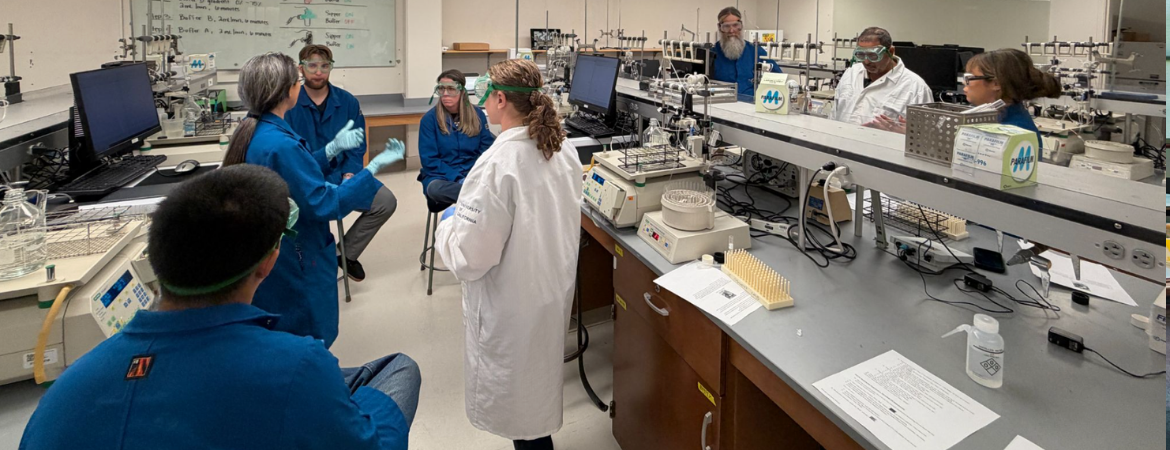
Dingwall led a morning biochemistry lecture and workshop before the group moved to the Biochemistry teaching laboratories in Pierce Hall for an afternoon laboratory experience.
Working with Dingwall and Biochemistry Lab Assistant Klarissa Quintana, teachers performed an ion exchange experiment, separating proteins based on their chemical properties and using low-pressure liquid chromatography equipment to observe the results.
For many, being back in a laboratory also meant remembering what it feels like to be a student.
“Being back in the lab makes me feel like a student again and gives me more empathy for what my students experience when they're uncertain or trying to figure out what to do,” said Scott Kirkwood, an eighth-grade science and engineering teacher at Amelia Earhart Middle School.
That experience was intentional.
Heather MacDonald, Secondary Science Teacher on Special Assignment for Riverside Unified School District, said teachers can become so familiar with the subjects they teach that it can be easy to forget what it feels like to encounter something for the first time.
“When you are a teacher, you don't always remember what it feels like not to know something, not to understand a concept or not to know how to approach a problem,” MacDonald said. Putting teachers back into unfamiliar learning situations, she said, “helps to remind us that our students are also in that place, and to have a sense of empathy when they are learning.”
For Carlo Rozzi, a seventh- and eighth-grade science teacher at Amelia Earhart Middle School, working in a university laboratory also offered a glimpse of what his students may encounter later in their education.
“The lab experience was amazing because it showed me the level of precision expected of university students,” Rozzi said. “The more I can encourage my students to develop that sense of precision and attention to detail, the better prepared they'll be for higher-level science.”
Bringing the experience back to students
For Riverside Unified's Smith, connecting teachers directly with university researchers helps them stay current in fields that are constantly evolving while also giving them a better understanding of what may await their students after high school.
“Science is continually changing, so giving teachers opportunities to stay current in their content areas really makes a difference,” Smith said. “UCR faculty not only share the science, but help teachers think about how it can apply in middle and high school classrooms and give them a view of what their students may experience in the future.”
For Quintana, helping teachers make those connections carries particular meaning.
A UCR alumna, Quintana began as an undergraduate in 2017, earned her bachelor's degree in 2021 and joined UCR's Biochemistry teaching laboratories in 2022. She later returned as a graduate student, earning her master's degree in 2025.
Now, instead of learning in the laboratory, she helps teach the students who come through it.
“My main takeaway here is that I hope they can go back to their home schools and tell their students and get them excited about the science that awaits them outside of middle school and high school,” Quintana said.
A first-generation college graduate, Quintana said she wants younger students to remain curious about what might be possible for them.
“Ask all the questions. Be curious. Don't be afraid to look silly because you don't know something,” she said. “Try everything.”
That ripple effect — from researchers to teachers and ultimately to their students — is at the heart of the symposium.
Dingwall described it as creating a spark.
A teacher might leave UCR having encountered a new scientific concept, research project or laboratory experience and bring that enthusiasm back into a classroom.
“One spark can catalyze a whole series of new sparks,” Dingwall said. “That's what I hope they take away from the experience — the excitement of learning something new and sharing that excitement with their students.”
For MacDonald, the growing partnership also gives local educators access to something just a few miles from many of their classrooms: the expertise and resources of a research university.
“For me, the partnership creates a strong sense of support — support from a university where many of our students continue their education, and support for our teachers as they continue to learn and grow in their profession,” MacDonald said. “Having that support and access to UCR's expertise is invaluable.”
Let us help you with your search