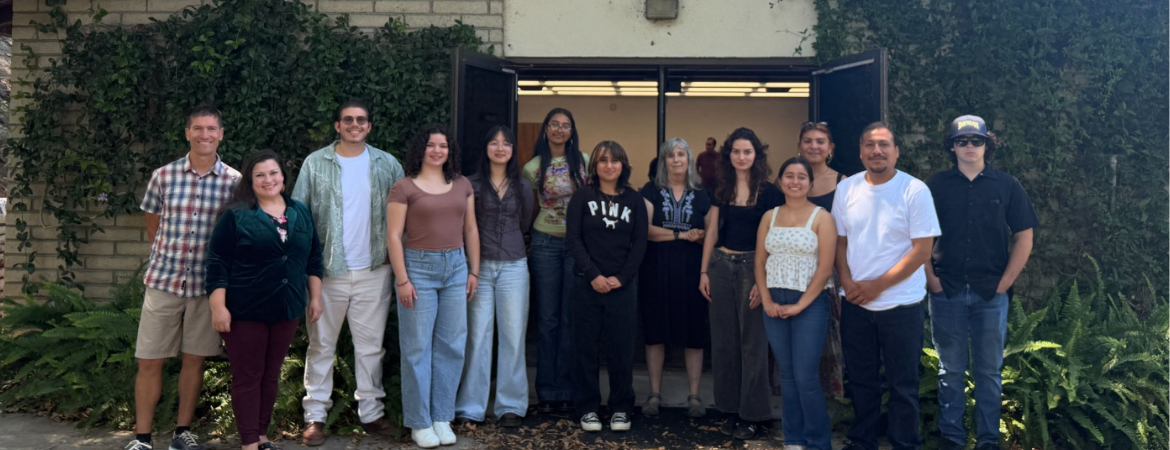
For 11 undergraduate students, summer research at UC Riverside meant counting butterflies, tracking bumblebees, studying forest ecosystems, monitoring desert tortoises and spending long days — and sometimes nights — conducting research in some of Southern California’s most distinctive natural environments.
The students gathered at UC Riverside on Aug. 14 to share what they learned through the UCR Natural Reserve System’s Experiential Internship, a summer program that pairs undergraduates with UCR researchers for hands-on field and laboratory experience.
Over the course of the summer, students worked alongside faculty, graduate students and other researchers on projects connected to UCR’s six natural reserves, which stretch from inland valleys and mountains to the Mojave and Colorado deserts.
For Tim Higham, Director of the UCR Natural Reserve System, or NRS, the purpose of the internship extends beyond completing a research project.
“The general idea of the internship itself is to give students field experience and research experience,” Higham said. “We want them to experience nature, see what science is like in nature.”
That experience, he said, can inspire students to pursue field research and conservation — or help them discover that another area of science is a better fit.
“The idea is to give students opportunities to do research in the field that normally they don't have access to,” Higham said.
Expanding access to the natural world
That idea has been central to the internship since its beginning.
The program grew out of conversations between UCR emeriti faculty members Nick Waser and Mary Price and Kim Hammond, who retired in April after serving as Director of the UCR NRS.
Waser and Price approached Hammond several years ago looking for a meaningful way to support the reserve system. Both had longstanding connections to UCR’s natural reserves and wanted their philanthropy to provide opportunities for future generations.
Hammond saw an opportunity to do something different: expand access to the reserves and the experiences they make possible.
Together, Hammond, Waser and Price began developing an internship that would introduce students to field research while opening the program to students beyond UCR — including students from California State Universities and community colleges.
The first cohort participated in 2020.
“We wanted to welcome students who had not previously had access to these kinds of opportunities,” Hammond said. “Their gratitude underscores how meaningful that access can be.”
Waser and Price initially committed $400,000 to the effort. Their support has since grown to more than $1 million, according to Hammond, providing sustained funding for students to participate in the program.
That investment has helped turn the internship into more than a summer research experience. Hammond said former participants have gone on to graduate school, conservation work and other careers, while others have changed how they think about their majors and future careers.
The program was intentionally opened to students outside UCR, she said, in part to help students from community colleges and other universities see themselves as part of the UC research environment.
“It gives students at community colleges and other higher education institutions a chance to feel connected to the UC system,” Hammond said. “And that’s powerful in and of itself.”
Learning science by doing it
For faculty members, the internship also creates opportunities to introduce students to research while exploring new scientific questions.
Zachary MacDonald, an Assistant Professor of Entomology who joined the program as a faculty mentor for the first time this summer, worked with UCR Environmental Sciences student Bailey Vontoure and Chaffey College biology student Minal Rizvi to begin developing a standardized butterfly monitoring program.
The students conducted surveys on the UCR campus and at Box Springs Reserve, helping establish a methodology that could eventually be expanded across additional UCR reserves.
MacDonald said the project provided an opportunity to design research that undergraduates can meaningfully contribute to even when they may only spend a summer in a laboratory.
It also gave him, as a newer UCR faculty member, an immediate introduction to the university’s reserve system.
“One of the things that the UC system is best known for is that it has its own reserve system, which is incredible for a university to have a network of protected areas,” MacDonald said.
For Vontoure, who hopes to pursue a career connected to conservation and eventually work in natural reserve management, the experience helped confirm an interest she already had.
“I loved it,” Vontoure said. “My favorite part would be the mentorship. I got so much advice. I learned so many things. It was wonderful being outside, interacting with the world.”
Minal Rizvi came to the program from a different starting point. She had never conducted research or taken an ecology course and saw the internship as an opportunity to try something new.
Although she ultimately decided that ecology isn't the professional path she wants to pursue, she said that discovery was itself valuable.
“I think it’s really important to experience new things and see what you like and don’t like,” Rizvi said. “I would definitely recommend it.”
That opportunity to explore is an important part of the internship, said Erin Rankin, Professor and Vice Chair of Entomology, who has served as an NRS faculty mentor for three years.
Rankin’s intern, Cal Poly Pomona environmental biology student Reese Buckway, worked on several projects during the summer, including research involving native bees and plants, invasive cotton seed bugs and butterfly monitoring.
“We really wanted to give the students experience with many different types of monitoring, many different types of lab methods,” Rankin said, “so that they would have a good idea of what kinds of questions they can answer and have marketable skills in ecology or conservation research moving forward.”
Buckway sought out the internship specifically because she had never conducted field research.
“It was a good experience to see if I could handle it,” Buckway said. “Field research can be intense sometimes.”
The answer included learning not only what field research looks like, but how ecology can also be studied in a laboratory.
Research across Southern California
Other students spent their summer investigating questions across ecology, conservation and environmental science.
Projects included studying bumblebees and environmental DNA; examining how climate and prescribed burns affect soils; monitoring changes in Southern California forests; documenting insect biodiversity; and conducting ecological research in desert environments.
Wesley Cross, who worked with Associate Professor Marko Spasojevic’s lab on long-term monitoring of a San Jacinto forest, said during his final presentation that the internship gave him his first opportunity to conduct fieldwork and see firsthand how a graduate student carries out field research.
The experience, he said, inspired him to consider continuing field research in graduate school.
Strengthening relationships with Tribal Nations
The NRS internship has also expanded through partnerships that strengthen relationships between the UC Natural Reserve System and California Tribal Nations.
The Collaborative of Native Nations for Climate Transformation & Stewardship, or CNNCTS, supports efforts to build ongoing relationships among Tribal Nations, universities and natural lands around research, education and stewardship.
This summer, Liz Garcia returned for a second year with the NRS and lived and worked at the James San Jacinto Mountains Reserve. Her work included helping rethink spaces within the reserve’s Trailfinders Lodge, learning how a field station operates and engaging with researchers, community members and members of Tribal communities with ancestral connections to the land.
Hammond said partnerships such as CNNCTS have helped the NRS strengthen relationships with Tribal Nations while creating opportunities for shared knowledge and stewardship of natural lands.
“Sharing of knowledge is essential,” Hammond said. “That collaborative stewardship is invaluable for the future.”
Finding what comes next
At the Aug. 14 gathering, students presented their work to faculty, mentors, fellow interns and members of the NRS community.
Higham thanked the faculty members and graduate students who helped mentor the interns and recognized Hammond for helping build the program that continues today.
For Hammond, watching another group of students complete the internship offered another example of what she hoped the program would accomplish when it began six years ago.
Students do not need to leave the program determined to become scientists, she said. What matters is that they have had the opportunity to experience research, spend time in natural environments and discover possibilities they may not previously have considered.
“Every student you can get out there who appreciates the natural world and understands its place on Earth is really important,” Hammond said.
For some, that experience may also offer a first glimpse of themselves as future researchers, conservation professionals or graduate students.
For more information about the UCR Natural Reserve System Experiential Internship and future opportunities to participate, visit the NRS Experiential Internship website.
Support the UCR Natural Reserve System
Private support helps the UCR Natural Reserve System provide protected natural areas for research, teaching and public service, while creating opportunities for students to gain hands-on research experience. Those interested in supporting the NRS can contribute to the NRS Experiential Internship Fund or other reserve, research and conservation funds.
Visit the UCR Natural Reserves giving page to learn more.
Let us help you with your search