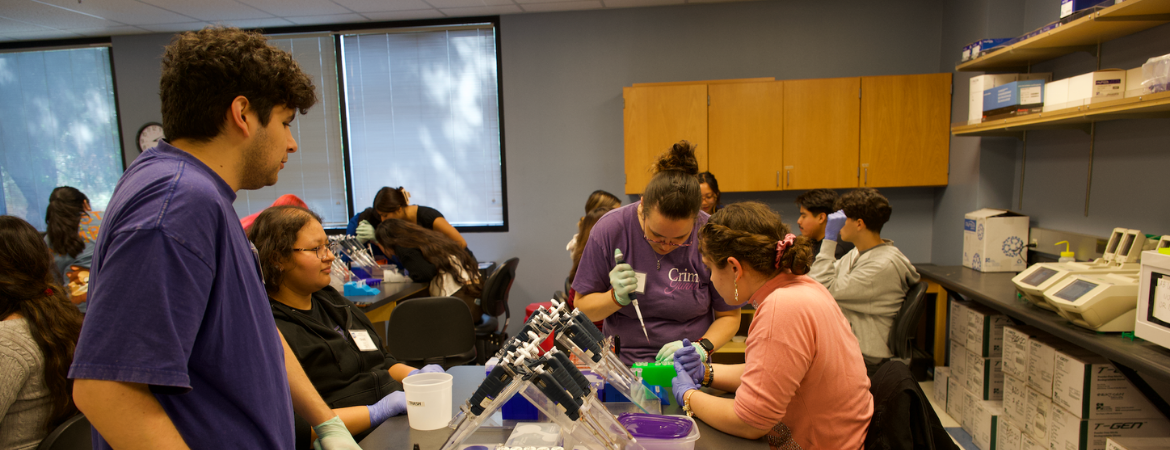
For community college students considering a future in science, spending a day in a university research laboratory can help them see what that future might look like.
This fall, UC Riverside's Sequencing to Success program will once again invite community college students to campus for a free, two-day molecular biology workshop that combines hands-on research with an introduction to UCR and the College of Natural & Agricultural Sciences.
Applications are now open for the Sequencing to Success program, which will bring community college students to UCR for laboratory research on Oct. 3 and a research poster session and campus tour on Oct. 17.
“We want them to experience lab work at a research university and see that science is accessible to them,” said Jim Burnette, academic coordinator at UCR and one of the program's organizers. “And hopefully, some of them decide to apply to UCR in part because they had this experience.”
The workshop is built around a deceptively simple research question: Is the fish being sold at the supermarket correctly labeled?
Students bring fish samples to UCR and spend the first Saturday in the Campbell Hall Learning Laboratory extracting DNA, amplifying a gene using polymerase chain reaction, or PCR, and running their samples on agarose gels. Their samples are then prepared for DNA sequencing at UCR.
Once the sequencing results are available, students work in small groups to analyze the DNA sequences, explore evolutionary relationships among the fish species and prepare a scientific abstract and research poster.
Two weeks later, they return to UCR to present what they discovered.
“They go through the whole process — ask a question, do the work, get the data, analyze the data and present it,” Burnette said.
Building confidence through research
The experience can be particularly meaningful for community college students who have had limited opportunities to work in a research laboratory.
Burnette said some participants arrive unsure whether they are prepared to use equipment such as micropipettes or conduct university-level laboratory work. At UCR, they work with research-grade equipment.
“I’ve had students tell me, ‘Wow, I never thought I’d get to use a pipette,’ or that they weren’t sure they could do it,” Burnette said. “The experience shows them that they can.”
Sequencing to Success attracts students from community colleges throughout Southern California. Previous participants have come from Riverside City College, Mt. San Antonio College, Mt. San Jacinto College, San Bernardino Valley College and El Camino College, among others.
Students do not have to be science majors to participate. Burnette said the program seeks students interested in transferring to a four-year university, including those who may not have previously considered UCR.
Experiencing UCR as a prospective transfer student
Sequencing to Success began as a community college outreach program but evolved into something more after organizers began hearing from participants who wished they had experienced UCR before submitting their transfer applications.
The program was eventually moved from spring to fall so students could participate while considering where they might transfer.
Today, the laboratory experience is complemented by opportunities to meet CNAS faculty, staff and students and learn more about the college. Participants will also have an opportunity to tour campus with the CNAS Science Ambassadors during this year's program.
Current UCR students with the Dynamic Genome Outreach Group serve as mentors during the laboratory portion, working alongside community college students at each bench. They help participants learn laboratory techniques while also providing an informal connection to the UCR student experience.
During downtime in the experiments, visiting students are encouraged to ask their UCR counterparts about classes, student organizations and life on campus.
The experience concludes with a poster session in the Genomics Auditorium, where participants present their findings to one another, UCR faculty and staff, and invited family members.
Together, the research experience and exposure to campus give students an opportunity to see what studying science at UCR could look like.
Applications open for 2026 program
The first day of the 2026 Sequencing to Success program will be held Saturday, Oct. 3, from 8:30 a.m. to 4:30 p.m. at UC Riverside. Lunch and parking are provided.
Participants will return Saturday, Oct. 17, from 9 to 11:30 a.m. for the research poster session, followed by a campus tour from 11:30 a.m. to noon.
The program is free and open to current community college students. Applications are due Sept. 20, 2026, by 11:59 p.m.
Sequencing to Success is supported in large part by the Neil and Rochelle Campbell Presidential Chair for Innovations in Science Education, which supports science education and outreach programs at UCR.
Let us help you with your search