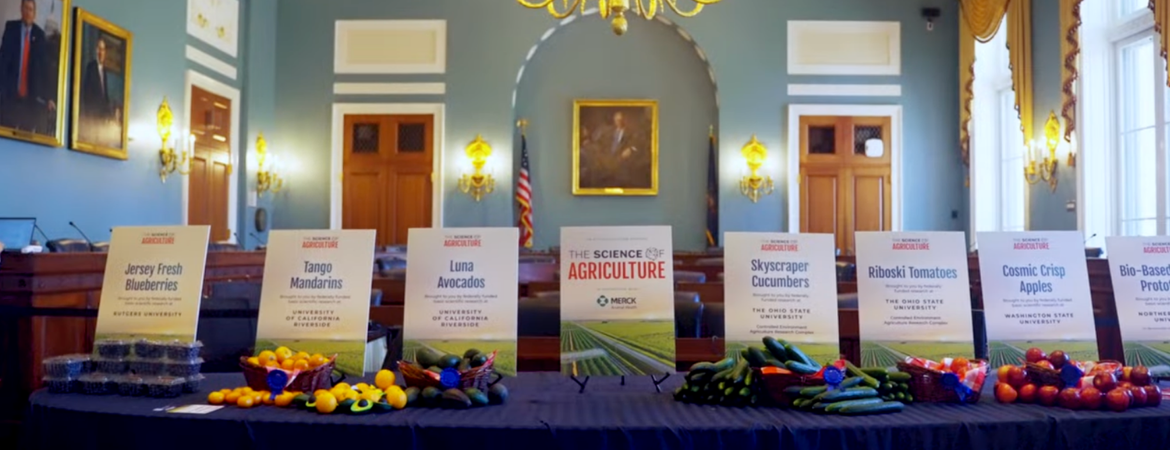
On a balcony outside the House Committee on Agriculture hearing room in the Longworth House Office Building in Washington, D.C., congressional staff, agricultural leaders and policymakers gathered around displays showcasing the future of American agriculture.
Representing six universities, each display featured agricultural innovations made possible through decades of scientific research. Participating institutions included The Ohio State University, Washington State University, University of Pennsylvania, Penn State, Rutgers University and UC Riverside.
At UC Riverside's table, a display of Luna UCR™ avocados and Tango mandarins told a much larger story.
The fruit represented far more than two successful varieties. They told the story of how more than a century of scientific discovery at UC Riverside's College of Natural & Agricultural Sciences (CNAS) has grown into an agricultural research enterprise that continues to shape the future of California agriculture.
A Legacy Rooted in Discovery
UC Riverside's agricultural story began in 1907 with the founding of the Citrus Experiment Station. More than a century later, that legacy has grown into a nationally recognized agricultural research enterprise, bringing together plant biologists, geneticists, breeders, Cooperative Extension specialists and industry partners to address California's most pressing agricultural challenges.
Today, that work continues through internationally recognized resources such as the Givaudan Citrus Variety Collection and collaborations that connect fundamental scientific discovery with practical solutions for growers.
That legacy was on display this summer when CNAS was selected as one of only six universities invited to participate in The Science of Agriculture, hosted by The Science Coalition on Capitol Hill.
The event brought together members of Congress, federal agency leaders, agricultural stakeholders and researchers to discuss the future of agricultural innovation and the importance of sustained investment in scientific research.
The invitation recognized more than individual research projects. It highlighted the strength of UC Riverside's agricultural research enterprise—and how decades of sustained scientific discovery continue to produce innovations that benefit California agriculture.
For Patricia Springer, Divisional Dean for Agriculture and Natural Resources, the event created an opportunity to tell a story that often unfolds behind the scenes.
"The goal was really to highlight the importance of research in driving agricultural innovation," Springer said.
From Discovery to Innovation
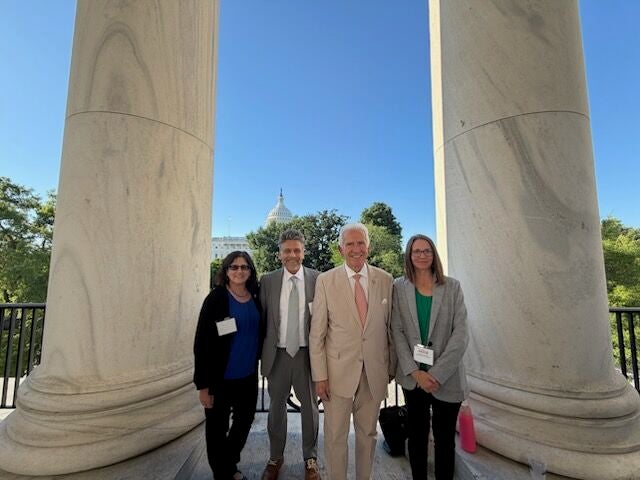
Joining Springer in Washington were Sean Cutler, Distinguished Professor of Plant Cell Biology, and Danelle Seymour, Assistant Professor of Genetics. Their complementary research demonstrates how basic scientific discovery evolves into practical agricultural innovation.
Cutler's research advances the fundamental science that expands our understanding of how plants respond to environmental challenges. Seymour builds on those discoveries by developing new citrus varieties specifically for California growers.
Together, they are helping accelerate the development of citrus varieties with greater tolerance to Huanglongbing (HLB), or citrus greening disease—one of the greatest long-term threats facing California's citrus industry.
"If we don't invest in research to breed better varieties and understand the underlying biology of this disease, we're going to be vulnerable to its effects," Cutler said. "It's important to the California economy. It's important to consumers."
For Seymour, the value of agricultural research extends well beyond the laboratory and the orchard.
"Both basic and applied science are connected to the everyday lives of people," Seymour said. "We consume agricultural products every day."
Developing a new citrus variety requires patience. In the best-case scenario, the process takes 15 to 20 years. When emerging threats like HLB put California citrus at risk, sustained federal investment allows researchers to focus intensely on developing solutions that will benefit growers for decades to come.
The Tango mandarins displayed in Washington represent discoveries made years ago that are now grown commercially around the world. Luna UCR™ reflects the next generation of innovation moving toward commercial production, with growers helping evaluate the variety under real-world conditions. Levi's Organic Avocados, a Ventura County grower that has partnered with UC Riverside in that work, generously provided the Luna UCR™ avocados displayed at the Capitol Hill event.
Together, Cutler's and Seymour's work demonstrates how investments in basic research today become the agricultural innovations that support growers, consumers and California agriculture tomorrow.
Beyond Capitol Hill
The event offered more than an opportunity to showcase research.
Being selected as one of only six participating universities underscored UC Riverside's long-standing leadership in agricultural research.
"Sometimes it's easy to forget that, because we're in Southern California, surrounded by millions and millions of people," Seymour said. "But being invited to this event is a recognition that we are leaders in agricultural research."
Throughout the day, researchers met with congressional offices, USDA officials and agricultural leaders to discuss the long-term partnerships that make agricultural innovation possible—from sustained research funding to industry collaboration and technology development.
For Springer, those conversations help ensure that when policymakers think about agricultural innovation—including citrus and avocado breeding—they also think about UC Riverside and the role its researchers play in addressing California's future agricultural challenges.
More than a century after the Citrus Experiment Station first took root in Riverside, its legacy continues to grow—not only in California's orchards, but in the discoveries that will shape agriculture for generations to come.
Those are the roots of innovation.
Let us help you with your search