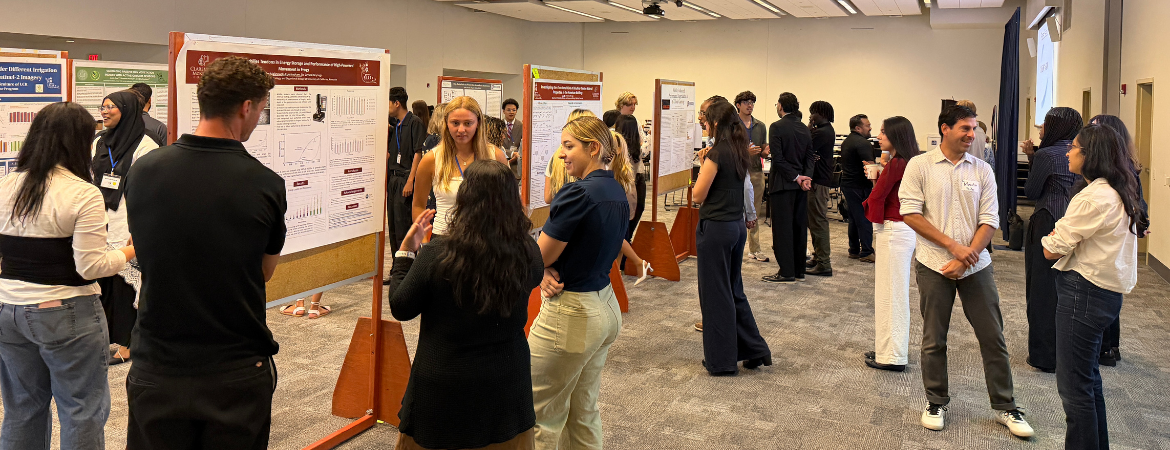
More than 50 community college and visiting university students spent their summer inside UC Riverside research labs, working alongside faculty and graduate student mentors and gaining firsthand experience with life at a major research university.
On Aug. 12, 53 students capped that experience at the first RISE 8-Week Summer Research Symposium, presenting research conducted across UCR during the summer through oral and poster presentations.
The eight-week program is part of the College of Natural & Agricultural Sciences’ Research in Science and Engineering, or RISE, program, which provides undergraduate students with faculty-mentored research experience, professional development and opportunities to become part of UCR’s research community.
For Amanda Arrieta, the pathway from community college student to UCR researcher is one she knows firsthand.
Arrieta first participated in RISE as a community college student before transferring to UCR in fall 2023. She later served as a RISE peer mentor, graduated from UCR this spring with a degree in biochemistry and now works as the program’s Assistant Coordinator.
“One of the most important parts of RISE is our community college partnerships,” Arrieta said. “Giving community college students the opportunity to conduct research at an R1 institution is pretty incredible.”
This year, the eight-week format brought together primarily community college students, along with students from other four-year institutions, through partnerships with colleges and programs across Southern California and beyond.
Participating partners included the Citrus College Summer Research Experience Program; MESA programs at Crafton Hills College, Santa Ana College and Mt. San Antonio College; Riverside City College’s Bridges 2 Baccalaureate Program; Fullerton College’s STEM Learning Communities; Xavier University’s UC-HBCU/BRiSP Summer Research Program; and Claremont McKenna College.
“Our partnerships with community colleges have continued to grow as more colleges and faculty learn about RISE and want their students to be part of the program,” said Noel Salunga, assistant director of Student Success Programs in CNAS and RISE program manager.
Because many partner institutions operate on semester calendars, RISE developed the eight-week option to better align with their academic schedules. The expansion has allowed the program to grow from roughly 25 students in previous summer cohorts to more than 50 participants in the eight-week program this year.
For Salunga, one of the greatest benefits is giving visiting students the opportunity to experience UCR as researchers.
“I think they can see a future for themselves here at UCR,” Salunga said.
For community college students, that experience can make UCR feel less abstract — and more like a possible next step.
Gunnar Kamizolas, a student at Fullerton College, came to RISE after learning about the program through his college. Over eight weeks, he worked in a UCR research lab studying mass spectrometry, gaining hands-on research experience as well as exposure to the everyday realities of scientific research.
“I got a lot of the hands-on experience I was looking for,” Kamizolas said. “But I was also exposed to all the different sides of research — working in the lab, doing computer analysis and reading scientific literature.”
Just as important were the relationships he formed with graduate student mentors and others in the program.
“The people for sure,” Kamizolas said when asked what stood out about UCR. “Everybody in this program has been extremely helpful.”
Kamizolas said UCR is now among the universities he is considering when he transfers from Fullerton College.
Throughout the summer, students worked with UCR faculty across a wide range of disciplines, including the natural sciences, engineering and education. At the symposium, nine students were selected to give oral presentations, while the remaining participants presented their research through posters.
Faculty mentors said the program also benefits UCR research groups by bringing new students and perspectives into their labs.
“RISE gives us the opportunity to work with students from colleges across the region and bring them into our research community,” said Elizabeth Rowen, assistant professor of entomology, who mentored four RISE students this summer.
Rowen said the students worked not only with faculty, but also closely with graduate students and one another, creating opportunities for collaboration and learning across different levels of experience.
That sense of community is also an important part of the program for graduate student mentors.
Semah Keissieh, a doctoral student in biochemistry and molecular biology who mentored Kamizolas, said she hopes students leave RISE with more than laboratory skills.
“It’s rewarding to work with students and help build their confidence as researchers,” Keissieh said. “I want them to see that university, higher education and research can be a place for them.”
For RISE organizers, that sense of possibility is part of the program’s purpose.
Whether students return to their community colleges, transfer to UCR or another university, or later consider UCR for graduate school, Salunga said the experience gives them an opportunity to see themselves as part of a research community.
“They can take it wherever they go and say, ‘UCR, for those eight weeks, was part of my academic growth,’” he said.
Let us help you with your search