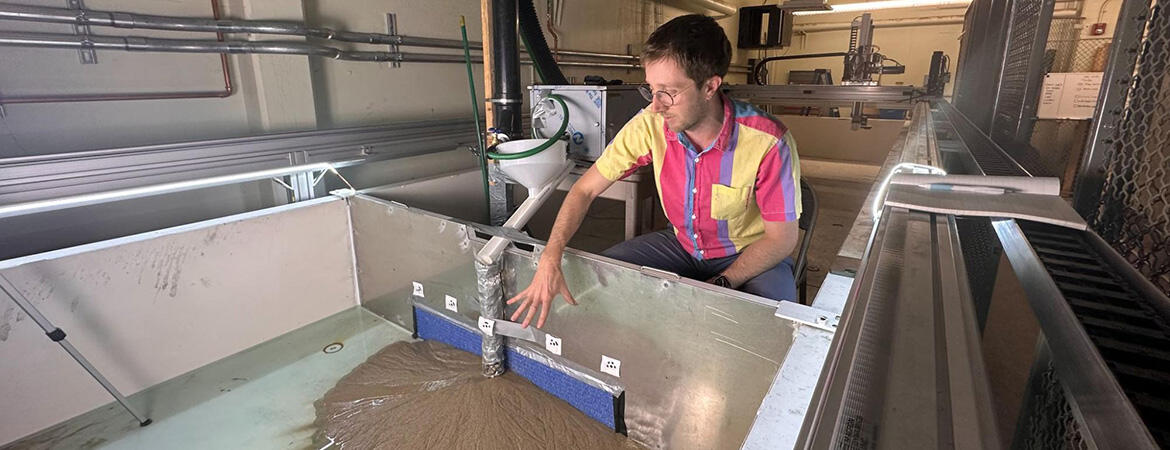
The Department of Earth & Planetary Sciences at the University of California, Riverside has launched the new UCR Experimental Landscapes Facility, an innovative research space designed to help scientists better understand how landscapes evolve over time.
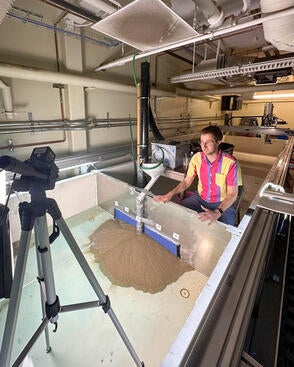
Led by Eric Barefoot, Assistant Professor of Earth & Planetary Sciences, the facility allows researchers to recreate scaled-down versions of natural environments — including river deltas, coastlines, and lake systems — to study how sediment moves and landscapes change.
“We’re interested in how landscapes evolve and how those landscapes eventually become the sedimentary rocks that preserve Earth’s history,” Barefoot said. “This facility allows us to scale down processes happening in the natural world and manipulate them in ways that help us better understand Earth, past and present.”
The experimental system uses flowing water, controlled sediment delivery, imaging technology, and robotic instrumentation to simulate and measure landscape formation with remarkable precision. Researchers can capture three-dimensional topographic data every 30 seconds, creating highly detailed records of how experimental deltas and sediment systems respond over time.
Barefoot said the facility will support research related to real-world environmental challenges, including changing water levels and sediment systems such as those impacting the Salton Sea region in Southern California.
Construction and development of the facility have taken approximately two years and involved collaboration among faculty, students, facilities teams, engineers, contractors, and research staff across UCR. Barefoot emphasized that the project represents a collective effort supported by the Department of Earth & Planetary Sciences, the College of Natural & Agricultural Sciences, the Bourns College of Engineering, and student researchers.
“We’ve had tremendous support from so many people across campus,” Barefoot said. “This facility is really the result of a collaborative effort.”
The Experimental Landscapes Facility is expected to support future research projects, student training opportunities, and expanded experimentation in sedimentology, geomorphology, and Earth surface processes.
###
Let us help you with your search