The UC Riverside community is mourning the loss of Emerita Professor Jodie Holt — a distinguished scientist, beloved educator, visionary leader, and passionate advocate for the natural world,whose influence shaped generations of students, colleagues, and visitors to the UCR Botanic Gardens.
Holt passed away on April 27, leaving behind a legacy deeply rooted in discovery, mentorship, and an enduring belief that plants could inspire wonder, curiosity, and connection.
Colleagues, students, and friends repeatedly returned to the same word when describing Holt: vision.
They spoke not only of her ambitious plans for the UCR Botanic Gardens, but of her ability to help others imagine what plants, public spaces, education, and community engagement could become. Holt believed plants had the power to inspire curiosity, connection, and wonder — and she spent her life helping others see that vision too.
For more than four decades, Holt served UC Riverside as a faculty member, researcher, mentor, and campus leader. She joined the UCR faculty in 1982 and built an internationally respected career in the Department of Botany and Plant Sciences, where her research advanced the understanding of weed ecology, invasive species, and plant physiology. Over the course of her career, she published extensively, mentored graduate students, and helped shape the field through both scholarship and leadership, including serving as department chair from 2003 to 2010.
But for many who knew her, Jodie Holt’s greatest gift was not simply her scientific expertise — it was the way she made people stop, look closer, and experience the natural world with a sense of wonder.
That belief shaped nearly everything she did.
She brought that same sense of curiosity and wonder into the classroom, where students often arrived expecting botany to be difficult or unremarkable and left with an entirely new perspective on plants and the world around them. In teaching evaluations collected over the years, students repeatedly described Holt as one of the most engaging and caring professors they encountered at UCR. Her impact as an educator was recognized campuswide when she received UC Riverside’s Academic Senate Distinguished Teaching Award in 2008–09, one of the university’s highest honors for excellence in teaching.
“She opened our eyes to the awesome world of plants,” one student wrote.
Another reflected, “I never thought I would enjoy learning about plants so much.”
Students frequently described Holt’s enthusiasm for the subject as contagious. They remembered how she brought live plant materials into class, encouraged curiosity, and connected scientific concepts to everyday life. Many said her courses permanently changed how they viewed the natural world.
“I don’t have plant blindness thanks to Dr. Holt,” one student wrote.
Long before public engagement in science became a common focus in higher education, Holt understood how important it was to help people connect emotionally with plants and the natural world.
In a 2010 interview about her work as a scientific advisor for James Cameron’s blockbuster film Avatar, Holt reflected on what she saw as one of botany’s greatest challenges: “People see plants as the green backdrop to their lives.”
Much of her life’s work was devoted to changing that.
Holt’s work on Avatar became one of the most unusual and memorable chapters of her career, bringing together science, storytelling, and popular culture in a way that perfectly reflected her personality and passions.
Recruited during the film’s development, Holt worked with actress Sigourney Weaver, director James Cameron, and the production team to help create scientifically credible plant life for the fictional moon Pandora. She advised filmmakers on how botanists study plants in the field, developed scientific descriptions and Latin names for fictional species, and helped shape the ecological logic behind Pandora’s alien environment.
“What botanist would not want to ‘discover’ new plants and name them herself?” Holt joked in an interview with the Los Angeles Times.
Even in Hollywood, Holt approached the work not simply as entertainment, but as an opportunity to inspire curiosity about plants and science.
Reflecting on the public response to Avatar in a later interview, Holt said people often told her that the film changed the way they noticed the natural world around them. “I walk outside and realize there are plants everywhere,” people would tell her.
For colleagues and friends, that excitement and sense of curiosity defined who she was.
“She loved plants,” said CNAS Dean Peter Atkinson, who worked closely with Holt for many years. “She understood their importance scientifically, environmentally, and aesthetically, and she wanted other people to appreciate them too.”
In 2016, Holt returned to campus leadership as director of the UCR Botanic Gardens, beginning what many colleagues describe as a transformative period for the Gardens and for the broader campus community.
Under her leadership, the Gardens expanded educational programming, strengthened public outreach, improved infrastructure and accessibility, and became a more visible destination across the Inland Empire. Holt envisioned the Gardens not only as a research and teaching resource, but as a place where the campus and surrounding community could gather, learn, explore, and reconnect with nature.
“She had a bold vision for what the Gardens could become,” Atkinson said. “She understood that the Gardens could serve as a place of beauty, education, research, and community engagement.”
That vision extended from major long-term projects to the smallest details. Colleagues recalled Holt’s excitement over new signage, trail improvements, maps, educational programs, and future ideas for expanded gathering and learning spaces.
Pam Ferre, Program Coordinator for the Botanic Gardens, said Holt created an environment where staff members felt valued and heard.
“She walked the walk,” Ferre said. “She listened to people. She included people. She invited us to share ideas and be part of the vision.”
Ferre described Holt as both a mentor and a friend whose leadership style centered on collaboration and encouragement rather than hierarchy.
“She provided a seat at the table,” Ferre said. “People felt like they mattered.”
Miguel Estrada, the Gardens Manager, said Holt trusted her staff and gave people room to grow professionally.
“Half the things I accomplished here would not have happened with anybody else,” Estrada said. “She really believed in what we were trying to do.”
But beyond her leadership, colleagues remembered Holt’s humanity — her humor, energy, thoughtfulness, and ability to make people feel appreciated.
Janine Almanzor, Curator of the UCR Botanic Gardens, laughed while remembering how Holt would hurry down the stairs at the Botanic Gardens office, moving quickly from one project or conversation to the next with unmistakable enthusiasm.
“She always had this energy about her,” Almanzor said.
Almanzor said Holt noticed everything. She paid attention to improvements in the Botanic Gardens, celebrated staff accomplishments, and made people feel seen.
“She always noticed the little things,” Almanzor said.
Multiple staff members also recalled Holt’s tradition of selecting personalized holiday gifts for every member of the Botanic Gardens team — small but meaningful gestures that reflected the care she brought to those she worked with.
“She made people feel valued,” Almanzor said. “There will never be another Jodie Holt.”
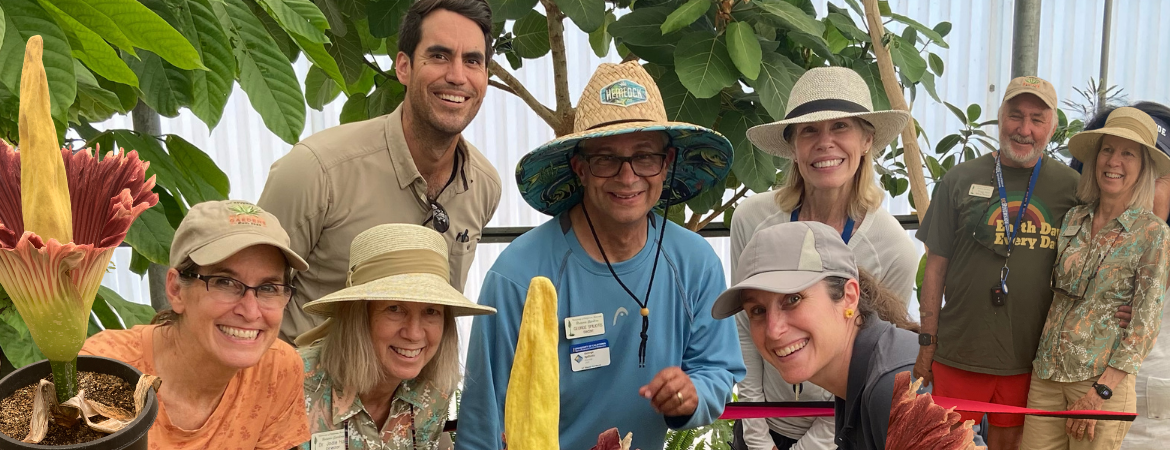
That same sense of excitement and connection helped define one of the most memorable moments in recent Botanic Gardens history: the 2022 bloom of the rare Amorphophallus titanum, better known as the corpse flower, which drew thousands of visitors to campus. Under Holt’s leadership, the event became more than a scientific curiosity — it became a community experience that introduced many people to the Botanic Gardens for the first time.
For colleagues, the enthusiasm surrounding the corpse flower reflected Holt’s larger philosophy: plants could captivate people if given the opportunity.
“She wanted people to connect with plants,” Ferre said. “That was always at the heart of what she did.”
For Patricia Springer, Divisional Dean of Agriculture and Natural Resources and one of Holt’s longtime colleagues and friends, Jodie’s optimism was inseparable from her vision.
“She was always a glass-half-full kind of person,” Springer said. “That optimism never left her.”
Springer said Holt approached both science and leadership with the belief that growth was always possible — in gardens, in students, in ideas, and in people.
“She saw potential everywhere,” Springer said.
Even while facing serious health challenges in recent years, Holt remained deeply engaged with the Botanic Gardens and the people around her. Friends and colleagues described her as resilient, hopeful, and determined to keep moving forward.
Outside of campus, Holt loved hiking, traveling, and spending time with her family. Colleagues fondly remembered stories about her husband, Doug, who handcrafted wooden signs for the Gardens, as well as the joy Holt found in being a grandmother.
Today, the pathways, plants, and gathering spaces throughout the UCR Botanic Gardens stand as one of the clearest reflections of Holt’s vision and spirit. But her legacy extends far beyond the landscape itself — into the students she inspired, the colleagues she mentored, the staff she empowered, and the countless people she encouraged to stop, look closer, and discover wonder in the living world around them.
Her legacy lives on in every student who pauses to look more closely at the natural world, every visitor who discovers wonder along the Garden pathways, and every person who, because of Jodie Holt, learned to see plants differently.
###
Let us help you with your search