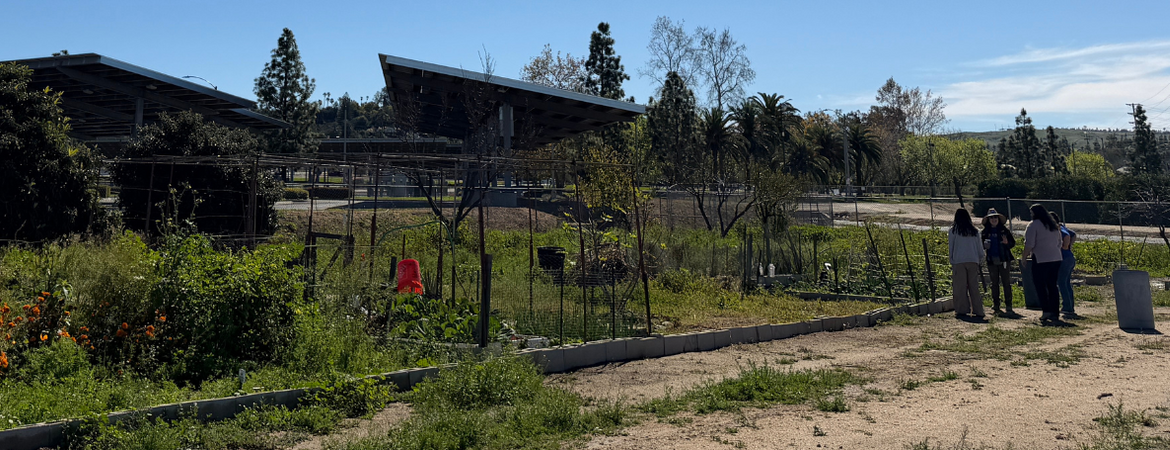
On a quiet stretch of campus near Lot 30, something different is happening.
There are rows of vegetables pushing up through the soil, pollinators drifting between native plants, and students kneeling in the dirt—talking, learning, laughing, working side by side. Some arrive for a volunteer shift. Others come for a class project. Some just want to see what it feels like to grow something with their own hands.
This is the R’Garden at UC Riverside — part living classroom, part community gathering place, and part personal sanctuary for the people who spend time there.
At its core, the R’Garden is rooted in addressing food insecurity within the UCR community—providing fresh, accessible produce to students while fostering hands-on learning and personal growth.
This year, the garden is entering a new chapter under faculty director Amy Litt and manager Crystal Brachetti, a UCR alumna whose own student journey began in this very space.
For Brachetti, R’Garden has always been more than a garden.
“I was taken aback by how much I felt at home in this space,” she said. “It reminded me of my grandma’s backyard. It felt welcoming, comfortable — like a place where people were really taking care of each other.”
She first came as a student looking for something simple — a campus gathering to meet fellow students. What she found instead was a sense of belonging she hadn’t expected.
“The R’Garden gave me camaraderie that I didn’t necessarily have by just going to class and going home,” she said. “It gave me autonomy and a sense of purpose I couldn’t have found just being in a classroom.”
Today, she helps create that same experience for others.
A place where learning feels real
For many students, college can feel abstract — lectures, labs, deadlines, and long days moving from one building to the next. The R’Garden offers something different: a place where learning happens outdoors, collaboratively, and visibly.
Faculty Director Amy Litt sees that as central to the garden’s role.
“The R’Garden is a campus space where people can learn by doing,” she said. “It connects food, environment, science, and community in a very direct way.”
Students don’t need prior experience. They learn by showing up — weeding, planting, harvesting, observing. Some join volunteer days. Others help design programming or develop projects. Some simply spend time working alongside peers.
“Students don’t need gardening experience,” Litt said. “What matters is commitment — being willing to participate and learn.”
Connecting science to everyday life
For CNAS Dean Peter Atkinson, the R’Garden helps bridge something many people don’t realize: how food actually reaches their table.
“Agriculture is often taken for granted,” he said. “We assume there will always be produce available. But there is much more behind that — the science, the resources, the challenges.”
He sees R’Garden as a way to make those invisible systems visible.
“It illustrates, by example, what we do at UC Riverside,” he said. “Not just producing food, but understanding how we grow it — from seed to harvest — and why that knowledge matters.”
That connection is especially meaningful in Southern California, where changing climate conditions are reshaping agriculture. Understanding how to grow food sustainably in challenging environments is increasingly critical — locally and globally.
But at the R’Garden, those big ideas become tangible. Students see growth happen in real time. They learn through observation, experimentation, and collaboration.
A space for community — and possibility
The garden itself spans about three acres and includes both row crops and individual community plots maintained by campus-affiliated participants. But its impact extends beyond what grows in the soil.
For Brachetti, the most important outcomes are personal.
“My vision is for the R’Garden to be a platform for undergraduate growth,” she said. “A place where students can build confidence, develop skills, and discover what they’re capable of.”
That growth can look different for everyone. Some students explore sustainability. Others gain leadership experience. Some simply find a place where they can breathe, connect, and feel grounded.
“Workshops and hands-on projects really open the door,” Brachetti said. “Students come in curious, and then they start to see how much they can do — how much they can contribute.”
She sees the garden as a rare space where academic learning and personal experience intersect.
“It’s where different perspectives meet in the middle,” she said. “Whether you study science, social issues, art, or something else entirely — there’s a place for you here.”
Growing forward
With new leadership in place, the R’Garden is focused on expanding programming, strengthening partnerships across campus, and creating more opportunities for students to engage directly with the space.
Litt hopes to deepen academic connections. Brachetti is focused on student development and participation. Together, they are building structure, stability, and momentum.
Atkinson sees the work as part of something larger — connecting research, education, and community wellbeing.
“Good agriculture supports healthy societies,” he said. “If we understand how food systems work — and how to sustain them — that benefits everyone.”
But at ground level, the impact is simpler and more immediate.
Students plant seeds. They tend the soil. They watch something grow — sometimes for the first time.
And for many, that experience changes how they see themselves.
“It’s not just about growing food,” Brachetti said. “It’s about growing people.”
###
What is the R’Garden?
The R’Garden is UC Riverside’s campus garden near Lot 30. It serves as a hands-on learning environment where students and campus community members can explore sustainability, grow food, and participate in collaborative programming.
The space includes:
- Row crops that support campus sharing initiatives
- Community plots for campus-affiliated participants
- Volunteer opportunities and workshops
- Student-led projects and programming
How to get involved
Students, faculty, staff, and campus community members can:
- Join volunteer days
- Participate in workshops and events
- Connect through student organizations
- Explore community plot opportunities
- Stay up-to-date on Instagram @UCRCommunityGarden
Let us help you with your search