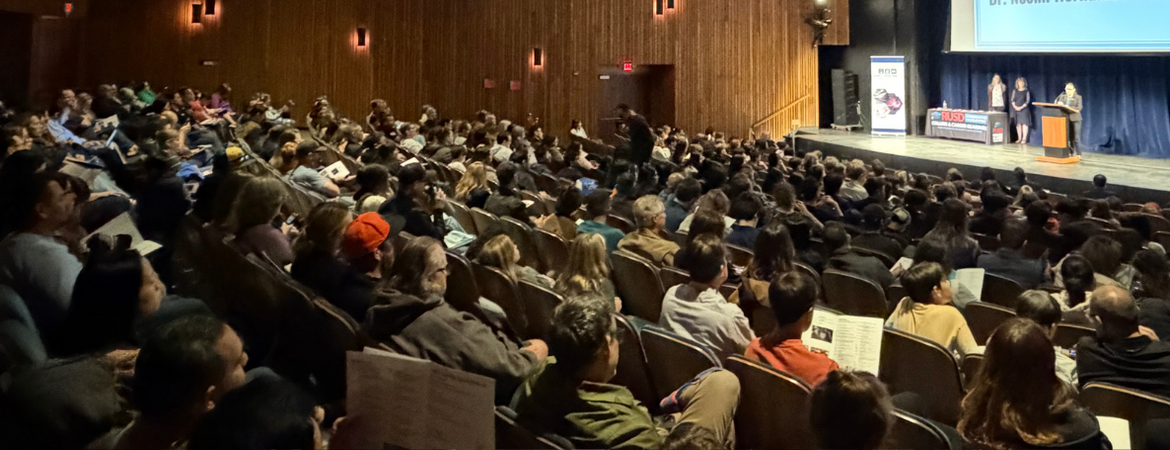
The University of California, Riverside College of Natural & Agricultural Sciences celebrated young scientific achievement on Friday, January 30, 2026, hosting awards ceremonies for both the Riverside Unified School District (RUSD) and the Val Verde Unified School District Science and Engineering Fairs.
The events marked the culmination of weeks — and in many cases months or years — of student research and experimentation. Families, teachers, and community members gathered on campus to recognize the work of student scientists whose projects explored topics ranging from environmental safety and public health to engineering innovation and agricultural sustainability.
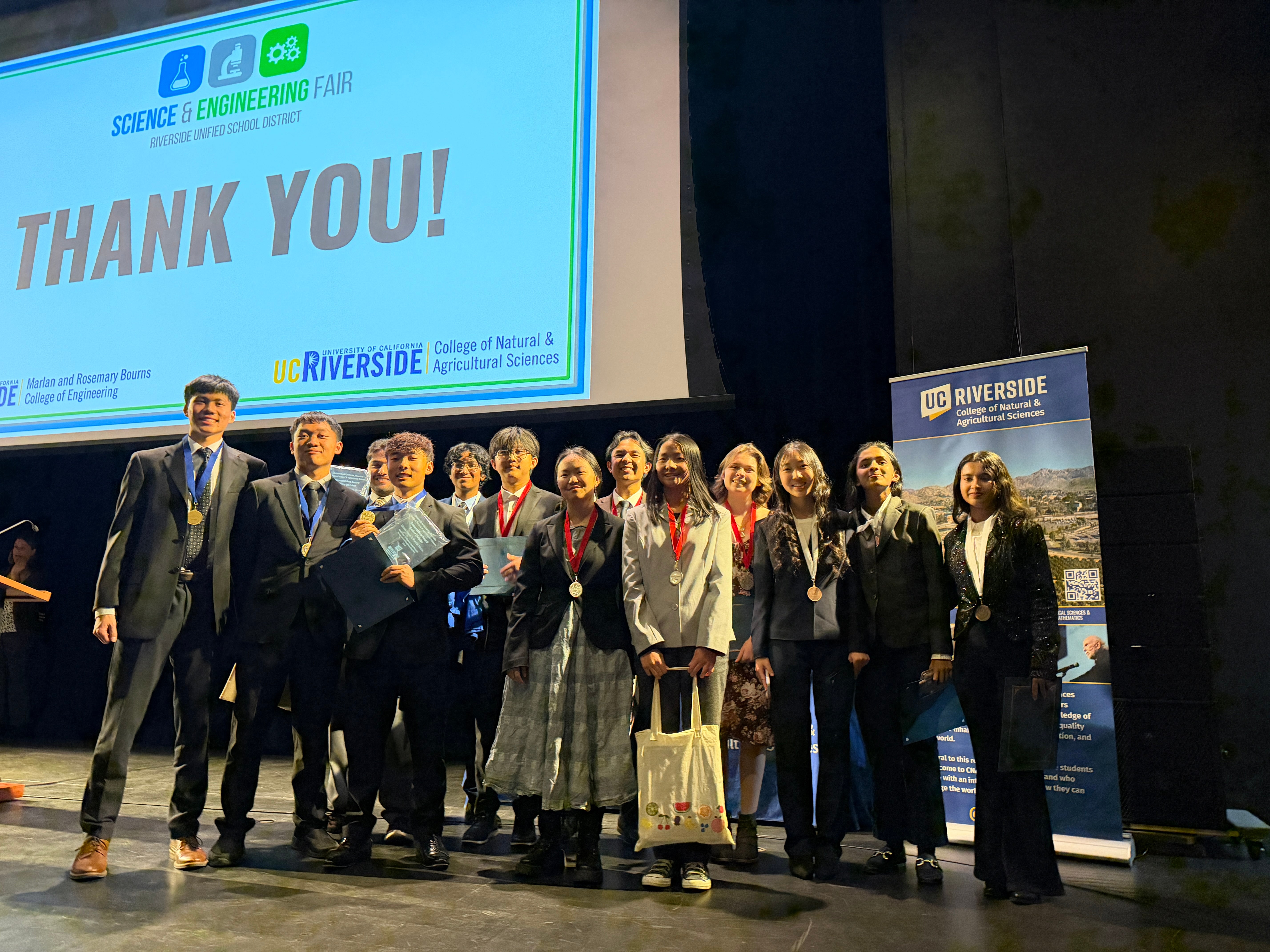
RUSD’s ceremony took place at University Theater, while Val Verde Unified held its celebration at the Student Success Center. For Val Verde, the evening was especially significant: it was the district’s first time hosting both its science fair and awards ceremony at UC Riverside. Student projects from the fair were also displayed that night, allowing families and community members to explore the research firsthand.
“This opportunity is bigger than anything we’ve done before,” said Leonesa Sanchez, Teacher on Special Assignment for Science Instruction at Val Verde Unified School District. “Our students are practicing how to communicate their ideas, share their research, and see themselves on a college campus. That kind of experience can be powerful — especially for students who may not have imagined themselves here before.”
CNAS leaders say the recognition ceremonies reflect more than academic accomplishment — they highlight the region’s growing pipeline of young scientists.
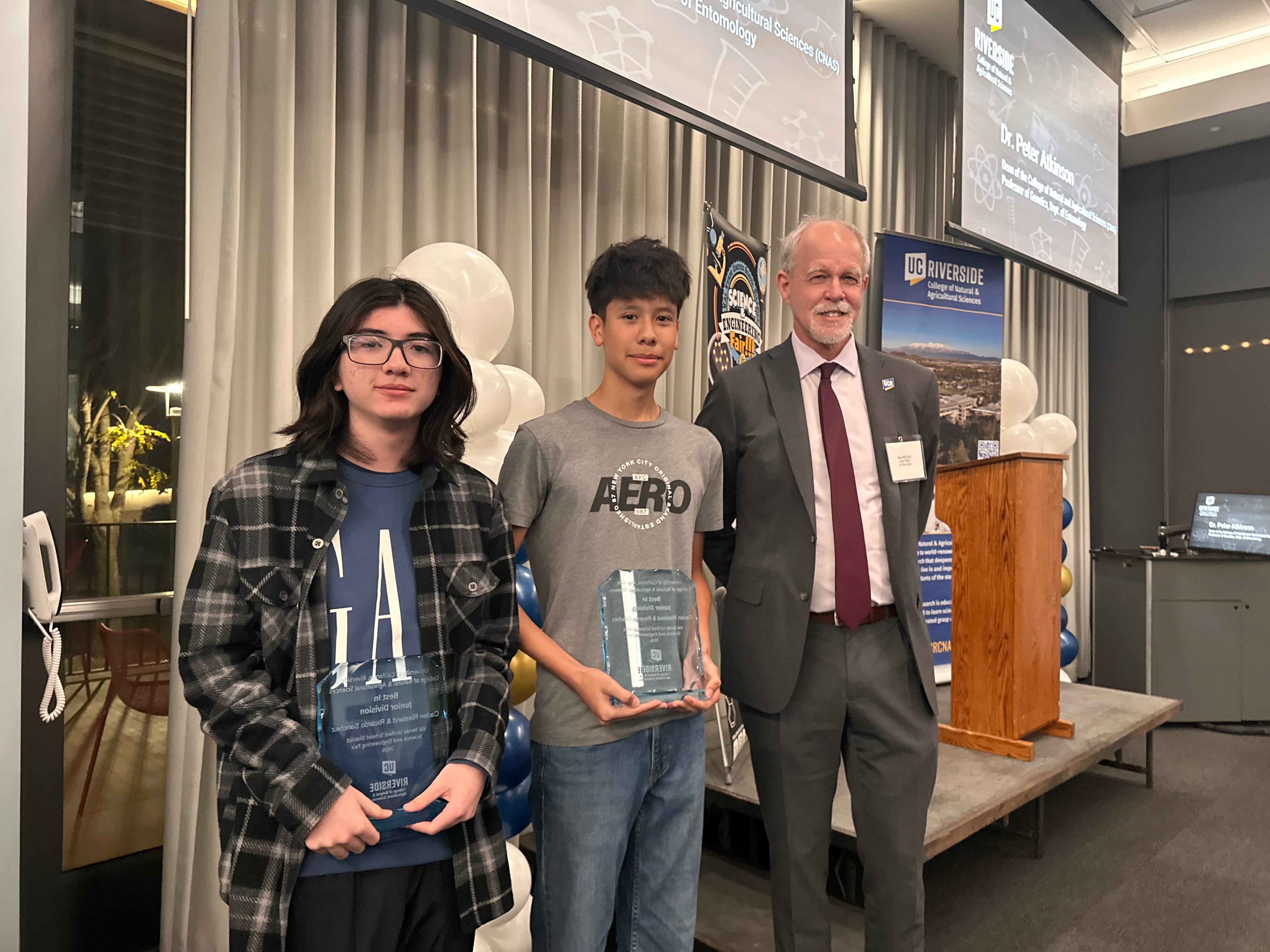
“These partnerships show that we are not some abstract group of academics,” said CNAS Dean Peter Atkinson. “We are here for our residents and our communities, and we are part of a continuous pipeline of future scientists, educators, and innovators.”
The awards also represent the collaborative effort behind each fair, including dozens of faculty, staff, and student volunteers who support judging and mentorship. Dr. Stephanie Dingwall, CNAS Divisional Dean of Student Academic Affairs, noted the breadth of participation across the college.
“We had judges from across disciplines — statistics, mathematics, physics, biochemistry, plant biology — and from all levels, including faculty, graduate students, and postdoctoral scholars,” Dingwall said. “It reflects how invested the university community is in supporting these students.”
For school district leaders, the awards ceremonies are as much about inspiration as recognition.
“It’s an opportunity for families and the community to see the range of ideas and creativity students bring to their research,” said Julie Smith, Instructional Services Specialist for TK–12 Science at Riverside Unified. “They get to see what students have accomplished and imagine what they can achieve next.”
CNAS Award Winners — Riverside Unified School District
Best in Elementary Division
The Power of Lemons — Maxwell Sanderson
Best in Junior Division
Autogenous Culex pipiens Sperm & Ova Production are Affected by the Intake of Distinct Caloric Sources — Joshua Curtis, Diego Diaz and Glenn Zhang
Best in Senior Division
Rational In-Silico Design of Multi-Functional Immunotherapeutic Peptides Targeting MHC-I Presentation, TCR Activation, and PD-1/PD-L1 Immune Checkpoints — Anthony Hernandez and Emmanuel Pudussery
Sweepstakes Award
Isolation of PFAS-Defluorinating Anaerobic Bacteria — Ubaid Awan & Patrick Moon
CNAS Award Winners — Val Verde Unified School District
Best in Elementary Division
Is the Water in Mead Valley Safe to Drink? Does Temperature and Location Affect pH and Levels of Calcium and Magnesium? — Julio Armenta Ibarra
Best in Junior Division
One Barrier to Rule Them All — Caden Rissland and Ricardo Sanchez
Best in Senior Division
Aggregate Stability and Carbon Stabilization Under Gamma Cyhalothrin Application — Francine Habacon
Sweepstakes Award
Windfall Profits: Optimizing Turbine Design — Athena Chacon and Michael Marquez
As both districts continue their partnership with UC Riverside, educators and university leaders alike see the awards ceremonies as a milestone — not an endpoint — in students’ scientific journeys. Each project recognized represents not only academic excellence, but the promise of future discovery emerging from classrooms across the Inland Empire.
###
Let us help you with your search