Before spending her summer studying desert tortoises in the Coachella Valley, Claudina Evans had a question she needed to answer about herself.
Could she really do this?
Evans, a biology student at Cal Poly Pomona, knew she was interested in field biology and research. But knowing that from a classroom and experiencing the realities of scientific fieldwork are two different things.
The UCR Natural Reserve System’s Experiential Internship gave her an opportunity to find out.
Over the summer, Evans conducted research at UCR’s Boyd Deep Canyon Desert Research Center, studying the nighttime behavior of Mojave Desert tortoises. The experience meant long days in the desert, learning new research methods, working through unexpected challenges and analyzing thousands of images captured by wildlife cameras.
By the end, Evans had an answer to her question.
“Before this internship, I was thinking, ‘Can I do this? Can I go to grad school?’” Evans said. “But now it’s, ‘I’m going to grad school.’”
Finding a path into research
Evans’ path to field research did not begin at a four-year university.
She attended Mt. San Antonio College before transferring to Cal Poly Pomona, where she began looking for opportunities to gain research experience beyond the classroom.
That can be challenging for students who are interested in science but don't yet have the experience or connections that can help them find their way into a research lab.
Evans saw the NRS internship as an entry point.
The program pairs undergraduate students from UCR and other colleges and universities with researchers for hands-on experience connected to UCR’s natural reserves. For Evans, it offered something she had been actively seeking: an opportunity to discover what conducting field research actually entails.
She was especially interested in field biology.
“I wanted to know if this is something I could actually do,” Evans said.
At Boyd Deep Canyon, she got the chance to find out.
What do tortoises do after dark?
Working with Kristy Cummings, a biologist with the U.S. Geological Survey; William Hoese, Professor of Biological Science at California State University, Fullerton; and Christopher Tracy, Station Director of UCR’s Boyd Deep Canyon Desert Research Center, Evans studied a deceptively simple question: What do Mojave Desert tortoises do at night
Much of what researchers know about tortoise behavior comes from observations during daylight hours. Evans’ project examined what happens after the sun goes down.
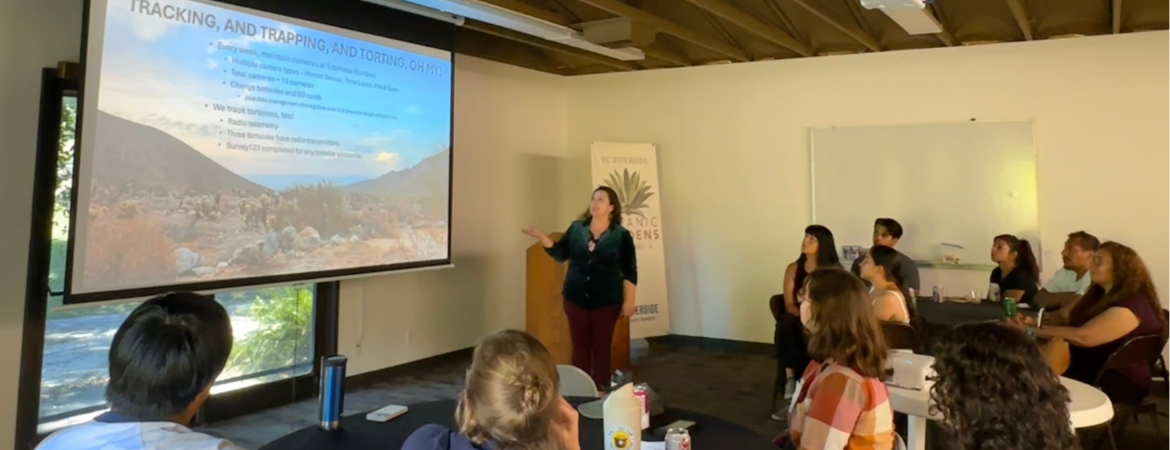
Using cameras placed near tortoise burrows, she collected and analyzed images to determine when tortoises emerged, how long they remained outside and what they did during nighttime hours.
Her preliminary observations offered intriguing clues. Some tortoises emerged three to five hours after sunset and remained outside their burrows for four to six hours. When they emerged at night, they often stayed out for much of the night.
But the project also taught Evans that field research rarely unfolds exactly as planned.
She had to develop protocols, troubleshoot equipment and environmental challenges, and work through enormous amounts of camera data. The desert itself presented another challenge, with researchers working in extreme summer conditions.
Those experiences helped her understand not only how scientific research is conducted, but what it takes to be the person conducting it.
“I learned so much about what it actually means to do research,” Evans said.
Seeing herself differently
Just as important as learning research methods was working alongside scientists who could help Evans envision where those experiences might lead.
Throughout the internship, she interacted with researchers at different stages of their careers and began learning more about graduate education and the paths available to someone interested in field biology.
That exposure changed the way she thought about her own future.
Graduate school, once something Evans wondered whether she was capable of pursuing, began to feel attainable.
Her experience also reinforced for her how important programs like the NRS internship can be for students who are curious about research but may not know how to enter that world.
Research opportunities can sometimes feel inaccessible from the outside, Evans said. An internship can provide the opening that allows a student to gain experience, build relationships and begin seeing themselves differently.
For Evans, that opening came in the desert.
By the time she presented her research at the NRS summer internship ceremony Aug. 14, she had gone from wondering whether she could handle field research to thinking about where it might take her next.
An opportunity made possible through philanthropy
Evans’ experience is part of an internship program made possible through the support of UCR emeriti faculty members Nick Waser and Mary Price.
Waser and Price worked with former UCR NRS Director Kim Hammond to establish an internship that would expand access to field research, including for students attending community colleges and other universities.
Their initial commitment of $400,000 has grown to more than $1 million in support for the NRS, according to Hammond, helping sustain opportunities for undergraduate students to work alongside researchers in UCR’s natural reserves.
Evans understands the impact of that support in deeply personal terms.
She said the investment Waser and Price made in students like her extends far beyond one summer. The experience will shape the researcher she becomes, the people she works with and, potentially, the students she may one day mentor herself.
“It’s not just affecting me,” Evans said. “It’s going to affect every person I interact with going forward.”
For Evans, the internship provided research experience. It provided mentors. And perhaps most importantly, it gave her confidence in herself as a scientist.
Graduate school is no longer a question of whether she can do it.
It’s now part of her plan.
Support student research experiences
Private support helps the UCR Natural Reserve System provide students from UCR and other colleges and universities with opportunities to participate in hands-on field research alongside university scientists. Gifts to the NRS Experiential Internship Fund help make experiences like Evans’ possible.
For information about supporting the internship or other UCR Natural Reserve System programs, visit the UCR Natural Reserves giving page.
Let us help you with your search