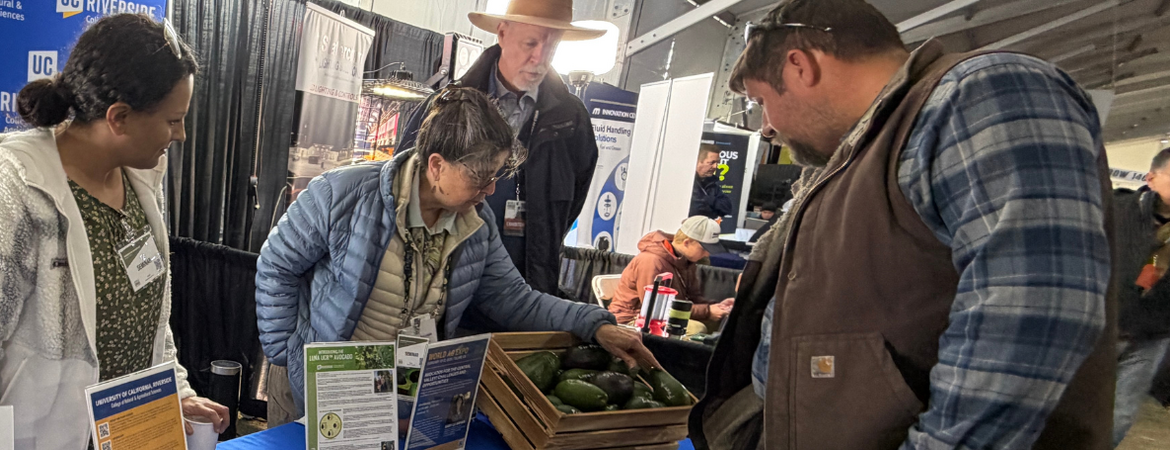
The UC Riverside College of Natural & Agricultural Sciences (CNAS) strengthened its presence in the agricultural community at the 2026 World Ag Expo (WAE), held February 10–13 in Tulare, California, building on last year’s successful debut with an expanded slate of faculty seminars and, for the first time, an interactive pavilion booth.
Over three days, 10 CNAS faculty members shared research spanning citrus and avocado breeding, crop production, soil health, strategies to address plant pests and diseases, weed science, precision agriculture, and emerging crop management strategies. The seminar series — now in its second year — continues to position UCR researchers as active contributors to real-world agricultural challenges while fostering dialogue with farmers, industry leaders, and community members.
“Our goal was to increase visibility for UCR’s agricultural research and educational programs across the broader agricultural community,” said Patricia Springer, CNAS Divisional Dean of Agricultural and Natural Resources. “World Ag Expo brings together everyone from small family farmers to large industry representatives, making it a powerful opportunity to reconnect UCR’s name with agriculture.”
For CNAS Dean Peter Atkinson, participation in events like World Ag Expo is central to the college’s long-term strategy. He emphasized that the expo allows CNAS to demonstrate its role not only as an educational institution, but as a research leader serving growers, industry partners, and future students.
“We want industry, educators, families, and prospective students to know that UC Riverside plays a major role in the agricultural industry,” Atkinson said. “We are the only Research 1 agricultural school in Southern California, and events like World Ag Expo help us increase our public profile and reconnect people with the work we do in agriculture and sustainability.”
Faculty reported lively discussions and meaningful engagement during the seminars, with several establishing new professional connections and potential collaborations. CNAS leaders plan to continue the seminar program and are exploring future enhancements, including continuing education credit opportunities for industry participants.
New this year, CNAS hosted a booth in the expo’s pavilion, creating a highly visible space for informal engagement and outreach. A highlight of the exhibit was a display of UCR’s collection of avocado varieties grown at the UC ANR South Coast Research and Extension Center in Irvine, which attracted strong interest from attendees. Visitors also explored citrus offerings — including Tangos and Washington navels — from the Lindcove Research and Extension Center. The Tango mandarin, a widely grown and commercially successful variety — marketed to consumers under brand names such as Cuties® and Halos® — was originally developed through years of citrus breeding research at UCR and released to growers in 2006, illustrating the university’s long-standing impact on the citrus industry. Conversations ranged from backyard tree care to commercial production practices, illustrating the broad reach of CNAS expertise.
Atkinson noted that the public response to the displays reflected a broader opportunity to share the science behind food production.
“People were drawn in by the avocados and citrus, but that opened the door to conversations about the research and innovation behind those crops,” he said. “That’s where we can show the real impact of our work — from plant breeding to sustainability to the future of agriculture in a changing climate.”
In addition to crop displays, visitors had the opportunity to explore insect monitoring tools and specimen collections presented by CNAS entomologist Houston Wilson. The exhibit featured examples of agricultural insect pests and trapping methods used in research and field management, offering attendees a closer look at how scientists monitor pest populations and develop effective control strategies. The display provided a tangible demonstration of integrated pest management research and sparked conversations about the role of entomology in protecting crop health.
The booth also created valuable opportunities for industry connection, including conversations with precision agriculture technology providers and other potential collaborators.
Beyond research visibility, CNAS leaders identified significant recruitment and outreach potential. The pavilion setting introduced UCR’s agricultural programs to visitors who may not have been actively seeking educational opportunities but were curious to learn more once they encountered the booth.
“This was only our second year with seminars and our first year with a booth,” Springer said. “The level of interest shows there is tremendous opportunity — not just for research partnerships, but also for student recruitment and public engagement.”
As CNAS continues to expand its presence at major industry gatherings, its growing engagement at World Ag Expo signals a renewed commitment to serving growers, advancing agricultural innovation, and ensuring UCR is recognized as a leading force in agricultural science and education.
CNAS Faculty Seminar Presentations at World Ag Expo
James Adaskaveg
Professor and Plant Pathologist
Department of Plant Pathology
New Fungicides for Citrus and Avocado
Researchers are developing new fungicides with high efficacy for managing major diseases affecting citrus and avocado. This presentation highlighted advances in disease control tools and their importance for protecting crop yield and quality.
Mary Lu Arpaia
Cooperative Extension Specialist
Department of Botany and Plant Sciences
Avocados for the Central Valley? Challenges and Opportunities
This presentation reviewed the history of avocado production in California’s Central Valley and examined the environmental, horticultural, and economic challenges and opportunities associated with expanding cultivation into this region.
Bodil Cass
Assistant Cooperative Extension Specialist
Department of Entomology
Augmentative Biological Control in Citrus and Dates
Growers are increasingly adopting integrated pest management strategies that rely on beneficial insects. This presentation explored augmentative biological control — the mass rearing and release of natural enemies — and how it supports sustainable pest management in citrus and date production systems.
Milton McGiffen
Cooperative Extension Specialist
Department of Botany and Plant Sciences
How to Manage the World’s Worst Weeds
A committee of experts identified purple nutsedge as one of the world’s most problematic weeds. This presentation discussed how understanding weed biology can improve management strategies and reduce economic losses in agricultural systems.
Sara Ohadi
Assistant Cooperative Extension Specialist
Department of Botany and Plant Sciences
Weed Science for a Changing California Agriculture
This presentation examined how shifting agricultural practices, climate conditions, and production systems are changing weed pressures in California and discussed emerging strategies to manage these evolving challenges.
Alexander Putman
Associate Cooperative Extension Specialist
Department of Plant Pathology
Combatting a New Strain of a Soilborne Lettuce Pathogen
Fusarium wilt of lettuce was long considered a manageable disease, but new strains are emerging that threaten production. This presentation discussed the pathogen’s biology, its increasing impact, and strategies for disease management and mitigation.
Danelle Seymour
Assistant Professor of Genetics
Department of Botany and Plant Sciences
Genetic Strategies to Facilitate the Development of New Citrus Varieties
This presentation examined current genetic strategies used to develop improved citrus varieties, including approaches that accelerate breeding and enhance desirable traits such as disease resistance, productivity, and fruit quality.
Amir Verdi
Associate Professor Agricultural and Urban Water Management
Department of Environmental Sciences
Drones for Yield and Salinity Mapping of Alfalfa in Southern California’s Desert Region
This presentation highlighted recently developed drone-based sensing technologies used to monitor crop yield and map soil salinity in alfalfa fields, offering new tools to support precision agriculture and water management in arid environments.
Houston Wilson
Associate Cooperative Extension Specialist
Department of Entomology
Influence of Winter Cover Crops and Sheep Grazing on Navel Orangeworm
Navel orangeworm is a major pest affecting California nut crops. This presentation examined how winter cover cropping and sheep grazing influence pest populations and orchard ecology, informing integrated management strategies.
Jiue-in Yang
Assistant Professor of Nematology
Department of Nematology
Beneficial Soil Microbes for Plant Parasitic Nematode Management
This presentation explored agricultural practices that support beneficial soil microbes and their role in suppressing plant-parasitic nematodes. Understanding these biological interactions can improve soil health and enhance sustainable crop production.
Let us help you with your search