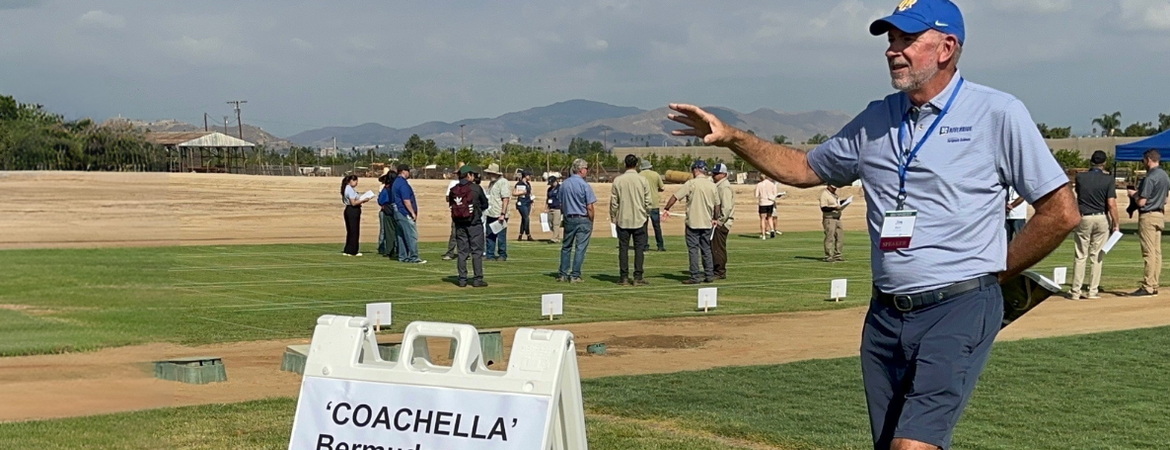
For more than a decade, UC Riverside has been advancing turfgrass research through a revitalized breeding program focused on performance, resilience, and environmental efficiency. One of its most significant outcomes is Coachella Bermudagrass — a new cultivar developed through collaborative research led by UCR Professor and Turfgrass Specialist, James H. Baird, and UCR Professor and Geneticist, Adam Lukaszewski.
Designed for golf courses, athletic fields, and managed landscapes, Coachella Bermudagrass reflects years of field evaluation and genetic selection aimed at improving seasonal color retention, drought tolerance, and overall turf performance in California’s diverse climates.
Revitalizing a Historic Research Program
UCR has a long history of turfgrass research, including foundational work by breeder Vic Youngner, whose bermudagrass and zoysiagrass cultivars remain in use today. After a period of inactivity, Baird and Lukaszewski reestablished the turfgrass breeding program in 2012, integrating plant genetics with applied turfgrass management.
Their early breeding crosses produced Coachella Bermudagrass, now installed at two Southern California golf courses, The Farms Golf Club in Rancho Santa Fe and Big Canyon Country Club in Newport Beach.
Baird will discuss the program’s research and development process as part of the CNAS Science Lecture Series at the UCR Palm Desert Center on March 3, 2026.
Performance-Driven Breeding
A central objective in developing Coachella Bermudagrass was improving winter color retention while exploiting strong drought tolerance. Researchers evaluated how bermudagrass responds to varying temperature patterns across coastal, inland, and elevated regions.
“The goal was to extend seasonal greenness while improving the stress tolerance bermudagrass is known for,” Baird explains.
The resulting cultivar demonstrates stable color retention under cooler conditions and strong adaptation to high temperatures and limited water availability.
Researchers also selected for darker blue-green pigmentation and structural traits that support uniform playing surfaces.
Coachella Bermudagrass and a related experimental cultivar currently under evaluation share these genetic characteristics.
Field Research and Expansion
UCR’s turfgrass research program continues to expand in scope and scale. The university now maintains the state’s only dedicated turfgrass research station, where multidisciplinary teams evaluate breeding lines under real-world environmental conditions.
“UC Riverside is now the only research station in California with a dedicated turfgrass focus,” says Peggy Mauk, director of agricultural operations and subtropical horticulture Cooperative Extension specialist at UCR. “The program has grown substantially in both scale and collaboration. It brings together plant breeders, pathologists, and applied scientists to address real-world challenges in turfgrass performance and management. UCR’s turfgrass research program is an incredible place with expertise in every area of science.”
Applied Research and Industry Collaboration
Much of Baird’s research is supported by the golf industry, which relies on turfgrass performance for both playability and resource management. Ongoing collaboration between researchers and industry professionals has focused on improving water efficiency and long-term turf sustainability.
Baird emphasizes that landscape water use depends heavily on irrigation practices as well as plant selection.
“Our work is centered on performance under responsible water management,” he says. “Advances in breeding and irrigation together create meaningful efficiency gains.”
A Career Dedicated to Turfgrass Science
Baird’s interest in turfgrass began early. Growing up in Pueblo, Colorado, he lived next to a municipal golf course, where exposure to course management sparked his interest in plant performance and landscape systems.
He earned his undergraduate degree in horticulture from Colorado State University, followed by a masters degree in agronomy and a doctoral degree in botany from Auburn University. After faculty positions at Oklahoma State and Michigan State, he spent eight years as an agronomist with the United States Golf Association before joining UC Riverside in 2008.
Today, he remains the UC system’s only turfgrass specialist.
Continuing Innovation
Demand for Coachella Bermudagrass continues to grow as additional field trials and installations demonstrate its performance across varied environments. Ongoing breeding work aims to further refine stress tolerance, seasonal color retention, and management efficiency.
For Baird and his colleagues, the program represents both scientific progress and long-term institutional commitment to applied agricultural research.
###
CNAS Science Lecture Series 2026
About the Series
The UC Riverside College of Natural & Agricultural Sciences (CNAS) presents its annual Science Lecture Series, showcasing innovative research by CNAS faculty and scientists. The series engages students, alumni, faculty, staff, and community members through discussions of scientific discoveries and their impact on local, national, and global challenges.
Featured Lecture
Innovating Turfgrass for a Water-Smart Future
Presented by James H. Baird, Ph.D.
Professor and Turfgrass Specialist, UC Riverside
In regions experiencing population growth, rising temperatures, and increasing pressure on water resources, turfgrass is often targeted for removal from the landscape. Dr. Baird will discuss the functional, aesthetic, and environmental roles of turfgrass, along with practical strategies for improving water efficiency in managed landscapes.
He will also highlight UC Riverside’s Turfgrass Breeding & Genetics Program and its progress in developing turfgrasses with enhanced drought resistance, including the new Coachella Bermudagrass.
Event Details
Date: Tuesday, March 3, 2026
Reception: 5:00–6:00 p.m.
Lecture: 6:00–7:00 p.m.
Location:
UC Riverside Palm Desert Center
75080 Frank Sinatra Drive
Palm Desert, CA 92211
Parking is complimentary.
What You’ll Learn
- The science behind Coachella Bermudagrass
- How turfgrass research supports water conservation
- Strategies for managing resilient landscapes with less water
- Emerging innovations in turfgrass breeding and genetics
- Education and career opportunities in turfgrass science
Who Should Attend
This event is free and open to the public. All are welcome, including:
- Community members and homeowners
- Landscape and turf professionals
- Industry partners
- Students (middle school through university)
- UCR faculty and staff
- Light refreshments will be served.
Registration
For more information or to register, visit sciencelectureseries.ucr.edu
Let us help you with your search